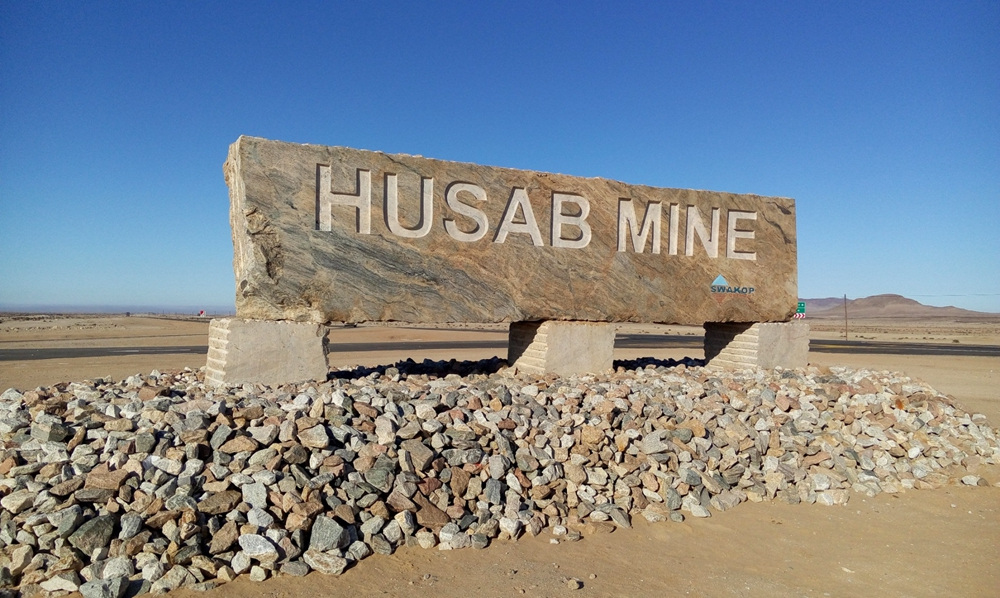
Swakop Uranium plans to invest approximately N$235 million in its 2026 exploration programme, with drilling activities expected to increase to about 100,000 metres of reverse circulation and diamond drilling, according to the Chamber of Mines of Namibia.
The planned programme follows an expanded exploration phase in 2025, during which the Husab Uranium Mine completed 72,000 metres of reverse circulation and diamond drilling across five deposits, representing a 41% increase compared to 2024.
Exploration expenditure during 2025 amounted to N$103.6 million.
“In collaboration with UNAM, CUGB and ECUT, the mine completed 1:10,000-scale geological mapping over more than 10 km², alongside over 16 km² of airborne radiometric and magnetic surveys, which identified several favourable mineralisation targets,” the Chamber said.
According to the Chamber, the exploration activities were supported by expanded geological mapping and geophysical surveys aimed at refining target identification within existing mining tenements near Swakopmund.
The Chamber said drilling results achieved during 2025 were complemented by continued technical evaluation of prospective zones, contributing to a stronger exploration pipeline heading into 2026.
“The 2026 exploration programme is set to intensify further, with approximately 100,000 metres of RC and diamond drilling planned at an investment of N$235 million,” the Chamber said.
The increased drilling programme forms part of ongoing resource expansion efforts at Husab, one of the world’s largest uranium mining operations.
This comes as production performance at Husab exceeded internal targets during 2025.
According to the Chamber, the mine moved 114 million tonnes of total ex-pit material, about 4% above target, while ex-pit ore production reached 14.6 million tonnes, approximately 28% above plan.
The processing plant milled 12.31 million tonnes during the year, achieved recoveries of 89.01%, and produced 5,429 tonnes of U₃O₈, all above planned output levels.
“Operational efficiency improvements were supported by technical interventions including slope monitoring systems, electronic detonator blasting, fatigue management tools, and mine-to-mill optimisation processes,” the Chamber said.
Additional systems introduced included belt tear detection technology, feed particle size monitoring and automated sampling systems to improve processing control.
The Chamber also reported that Swakop Uranium recorded turnover of N$16.1 billion and profit of N$8.2 billion during 2025, supported by strong production output and increased procurement activity.
“Total procurement expenditure reached N$11.95 billion, of which N$7.43 billion, or 62%, was sourced locally. Wages and salaries amounted to N$1.61 billion, while spending on training and skills development totalled N$47.97 million,” the Chamber said.
Royalties paid to the State amounted to N$494 million, while export levies totalled N$41 million.
Corporate tax was reported at zero due to an assessed tax loss position, according to the Chamber’s review.