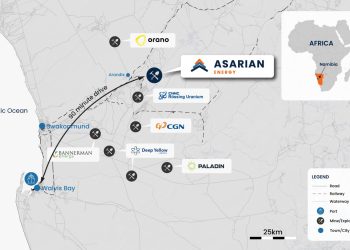
Arkle Resources says it has accelerated uranium exploration activities at its Erongo project in Namibia after identifying multiple high-priority drill targets and recording strong uranium assay results.
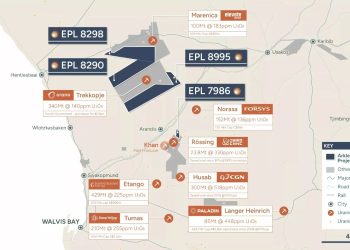
The company said it has completed interpretation of its Phase 1 geophysical programme across three northern Exclusive Prospecting Licences (EPLs) within the Erongo uranium belt, covering EPLs 8290, 8298 and 8995.
The interpretation combined airborne radiometric and magnetic surveys, ground horizontal loop electromagnetic (HLEM) data and 2025 surface assay results.
Arkle Interim Chief Executive Officer Rory Harding said the programme marks a major step forward in the company’s Namibian uranium exploration strategy.
“Completion of the Phase 1 geophysics interpretation is a defining moment for Arkle’s uranium strategy. The integrated work, supported by 2025 surface sampling and the input of our technical advisers, has fast-tracked a portfolio of high-priority uranium drill targets across two of the most productive mineralisation styles in the Erongo belt,” Harding said.
He said the strength of the exploration data has enabled the company to move into drilling earlier than originally planned.
“The quality of the data has allowed us to compress that timeline. The Eastern paleochannel target on EPL 8995 is now drill-ready and we are working to commence RC drilling in June,” Harding said.
Arkle said it is now planning approximately 4,000 metres of fully funded drilling across paleochannel and leucogranite targets in the Erongo uranium belt.
The company will initially focus on a 1,500-metre reverse circulation drilling programme targeting inferred sub-channel structures identified through geophysical modelling on EPL 8995.
Harding said trenching and sampling work will also begin next week on a large uraniferous leucogranite target ahead of a planned 2,500-metre drilling campaign scheduled for the third quarter of 2026.
The company said the target area measures approximately one kilometre by 700 metres and forms part of a broader mineralised system.
Arkle said its interpretation identified two uranium mineralisation styles across the licence areas, namely paleochannel-hosted deposits and uraniferous leucogranite systems.
Additional paleochannel and leucogranite targets have also been identified across EPLs 8290, 8298 and 8995 and will be advanced through further mapping, sampling and geophysical surveys.
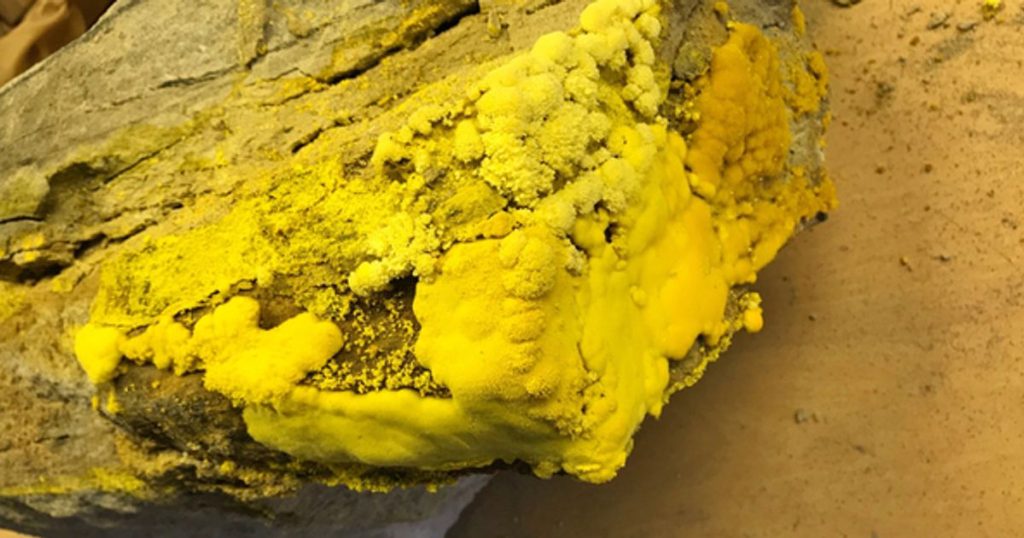
According to the company, surface sampling conducted in 2025 returned uranium grades of up to 3,855 parts per million U₃O₈ in alaskite samples and up to 2,782 parts per million U₃O₈ in calcrete samples.
Arkle said a downhole gamma ray spectrometer survey of legacy drillholes on EPL 8995 is ongoing, with approximately half of the planned 95 holes already completed.
The company expects the accelerated exploration programme to support sustained drilling and uranium exploration activities across its Erongo portfolio throughout 2026