Rhino Resources Namibia has confirmed the presence of an oil-bearing sandstone reservoir at its Capricornus-1A appraisal well offshore Namibia, strengthening confidence in the scale and continuity of the Capricornus discovery in the Orange Basin.
The Capricornus-1A well, drilled on Petroleum Exploration Licence (PEL) 85, encountered a 46-metre gross reservoir interval, with preliminary analysis confirming that the reservoir is in pressure communication with the earlier Capricornus-1X discovery.
The results provide further evidence that the hydrocarbon accumulation extends across the Capricornus fairway and will support the next phase of appraisal drilling.
The well was spudded on 2 May 2026 using the Saipem 12000 drillship in a water depth of 1,285 metres and reached a total measured depth of 4,818 metres on 11 June 2026. Rhino said drilling was completed safely and without incident.
During the campaign, the joint venture recovered a representative core from the main reservoir section and acquired a full suite of wireline logs and formation evaluation data to further assess the discovery.
Rhino said the core, pressure and wireline datasets will now be integrated with information from previous wells across PEL 85 to refine reservoir modelling and support ongoing appraisal and exploration activities.
Rhino Resources Chief Executive Officer Travis Smithard said the well had significantly improved the joint venture’s understanding of the Capricornus reservoir.
“The Capricornus-1A well has delivered important information that advances our understanding of the morphology of the Capricornus reservoir system. Confirmation of pressure communication with Capricornus-1X provides evidence of reservoir continuity across the accumulation and increases our drilling confidence as we continue to advance the appraisal of the Capricornus discovery.”
Smithard said the well had also provided valuable geological information from deeper formations that were not encountered in the original discovery well.
“The well has also provided critical information on deeper geological intervals that were not encountered at Capricornus-1X, improving our understanding of how subsurface structures are defining the play fairways across the licence area.”
He said the latest results, combined with data gathered from previous discoveries, would guide future drilling across the Capricornus accumulation and other exploration targets within PEL 85.
“Together with the extensive datasets gathered from our previous discoveries, these results provide further insights for our part of the Orange Basin and will help inform the next phase of appraisal drilling across the Capricornus accumulation and additional exploration targets across PEL 85.”
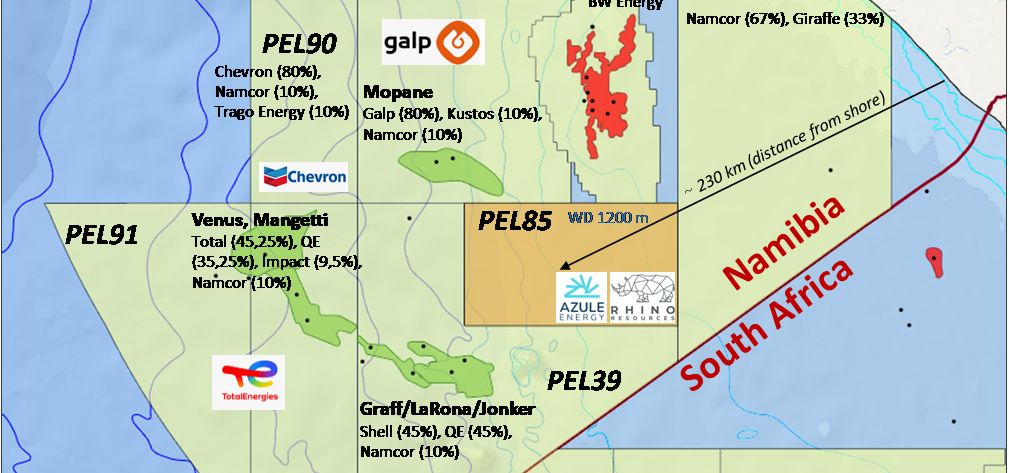
Rhino operates PEL 85 with a 42.5% working interest, alongside Azule Energy (42.5%), NAMCOR (10%) and Korres Investments (5%).