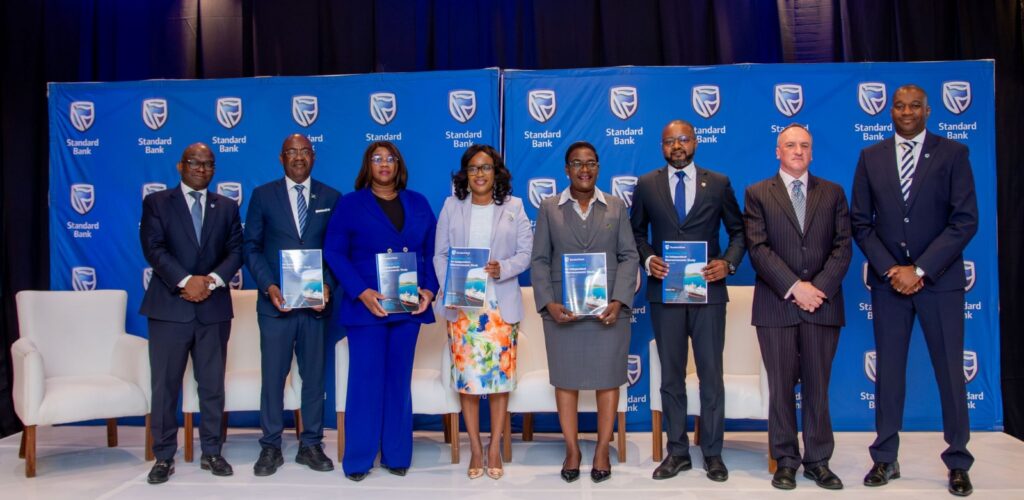
Namibia’s emerging oil and gas industry could generate up to 581,000 employment opportunities across the economy and contribute an average of US$18 billion annually to gross domestic product (GDP), according to a macroeconomic study commissioned by Standard Bank Namibia.
The independent study assessed the potential economic impact of the Venus, Capricornus and Mopane oil projects between 2026 and 2051, with employment gains largely dependent on reinvestment, local business participation and the expansion of petroleum-related economic activity into other sectors.
Standard Bank Group Head of Oil and Gas Coverage for Southern Africa, Paul Eardley-Taylor, said the three projects could also generate approximately US$15 billion in gross national income and up to US$55 billion in national capital formation.
The study further projects balance of payments benefits of around US$6 billion and more than US$5 billion in annual fiscal income.
Its projections are based on industry data and modelling assumptions, including information from Wood Mackenzie and the Natural Resource Governance Institute’s financial model.
Standard Bank Namibia Economist Helena Tunga Mboti said approximately 11,000 direct jobs could be created through oil and gas operations and supporting services, with broader employment gains dependent on reinvestment across the economy.
“The study’s direct jobs coming from direct oil and gas and the support services is only about 11,000 jobs as Paul had highlighted,” Mboti said.
She warned that without reinvestment and the distribution of petroleum revenues across other economic sectors, much of the projected employment potential could remain unrealised.
“89% of the jobs are reliant directly on the fact that reinvestment has to happen. And that the sectors have to sort of or the benefits have to be spread across the entire sectors. If we do not have that reinvestment in place then the 89 percent of jobs might not come into reality,” she said.
Standard Bank Namibia Chief Executive Officer Erwin Tjipuka cautioned that the projections were not guaranteed, as the three projects remained at different stages of development.
“These are projections not promises. They are based on a defined assumptions about projects that are still progressing towards development. As those projects evolve, the assumptions and therefore the outcome will evolve as well,” Tjipuka said.
He said Namibia’s priority should be ensuring that economic value generated through offshore petroleum production translates into domestic investment, employment and business opportunities.
“The real measure will be what the discovery ultimately mean for the lives and the livelihoods of Namibians. The question we need to ask is bigger than how much oil Namibia may produce. The question is how does the value created offshore find its way into the Namibian economy,” he said.
Presidential Special Adviser and Head of the Upstream Petroleum Unit Kornelia Shilunga said maximising local participation would require investment in skills development, technical capacity and entrepreneurship to ensure Namibian businesses benefit from the industry.
“The scale and complexity of this opportunity mean that none of us can work in isolation. Achieving this will require close collaboration between government, the international operators, Namibia businesses, financial institutions, universities and vocational training institutions,” Shilunga said.