Arkle Resources PLC says its latest exploration programme has confirmed that the uranium-bearing geological system at its Erongo Uranium Project extends at least 188 metres below surface, strengthening the potential for deeper mineralisation beneath its primary target in Namibia.
The London-listed explorer has completed 2,712 metres of reverse circulation drilling across 87 holes, significantly exceeding its original 1,500-metre drilling programme after exploration results justified additional work.
Nine reconnaissance holes drilled beneath recently completed trenches intersected uraniferous leucogranite over 792 metres, representing 69% of the 1,154 metres drilled within the target area. Three holes remained entirely within leucogranite from top to bottom, while the deepest drilling confirmed the rock unit to at least 188 metres below surface.
Arkle Chief Executive Officer Rory Harding said the drilling had moved the company’s understanding of the project beyond surface exploration.
“The drilling has taken us into the third dimension for the first time, and the nine holes we put into that footprint logged leucogranite over roughly seventy per cent of the metres drilled, with three of them in leucogranite from top to bottom and the deepest of them still in leucogranite at two hundred metres downhole.”
The company said laboratory assays will determine the uranium grades encountered during drilling, with results from the primary uraniferous leucogranite target expected later this month.
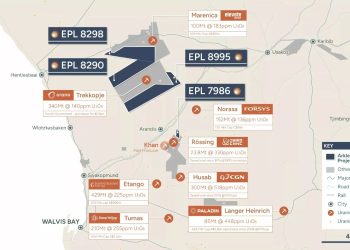
Surface exploration has meanwhile defined uranium mineralisation across approximately 1.5 kilometres of strike and up to 600 metres in width at the primary ULG target on EPL8995.
Arkle completed 1,973 line metres of trenching and analysed 271 samples, including 213 trench samples. Peak grades reached 800 parts per million (ppm) U₃O₈ from surface samples and 358 ppm U₃O₈ from trench samples.
A total of 39 samples returned uranium grades above 100 ppm U₃O₈, including 26 trench samples, while 13 samples exceeded 200 ppm. Arkle said every sample grading above 100 ppm was associated with leucogranite or contacts with the rock unit, reinforcing the geological relationship between the uranium mineralisation and the host rocks.
“The trench results we are reporting today are the first of those to come back, and they are encouraging. We now have identified a uranium system at the primary ULG target that we can trace at surface over roughly a kilometre and a half of strike and six hundred metres of width,” Harding said.
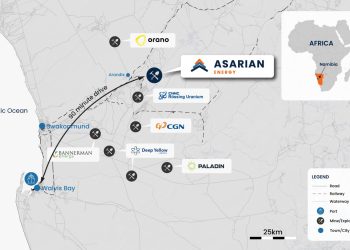
He said the geological setting mirrors the leucogranite-hosted uranium architecture found elsewhere in central Erongo, including Bannerman Energy’s Etango and Asarian Energy’s Norasa uranium projects.
The company has submitted 974 drill samples from the ULG target to Actlabs as part of a total 1,181 samples collected during the programme.
Arkle has resumed field mapping and sampling while planning additional trenching, ground geophysics and a follow-up drilling campaign as it works to identify further uranium targets across the licence area.
The company expects to release drilling assay results from both the ULG and paleochannel targets during September, together with drill sections and an integrated interpretation of the exploration results.