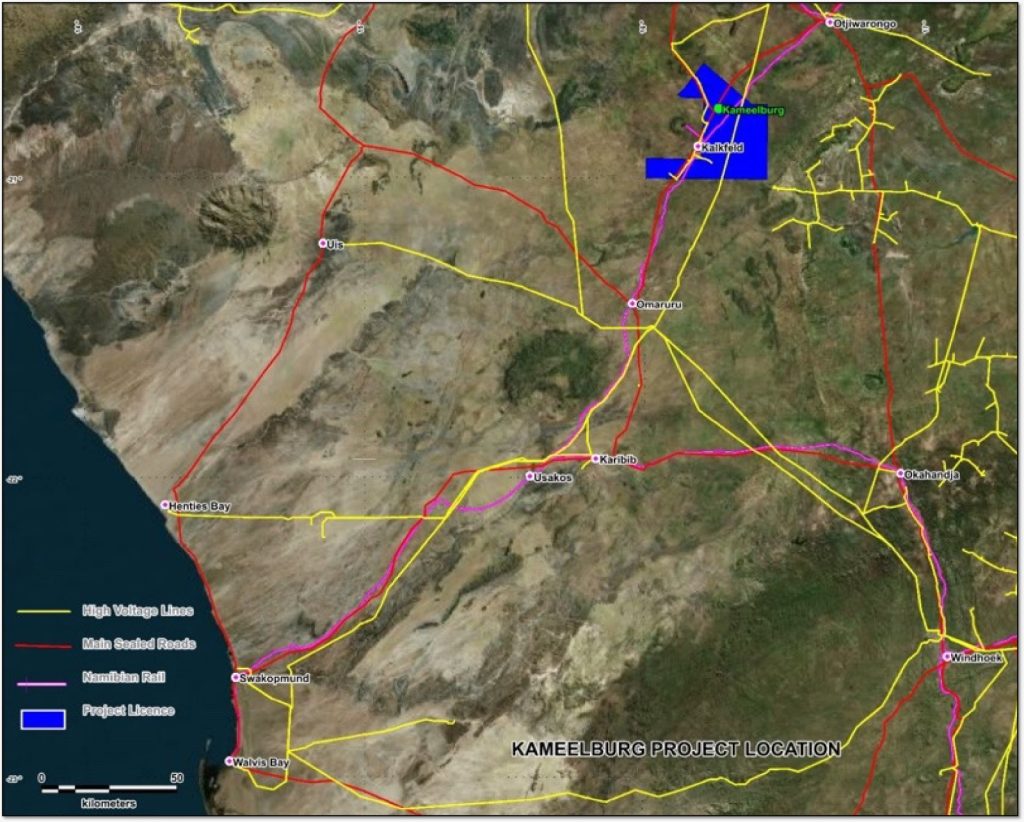
Australian-listed Aldoro Resources has declared its Kameelburg Project in Namibia the world’s largest strontium deposit after significantly upgrading the project’s mineral resource, strengthening its position in the global critical minerals market.
The company announced an updated independent JORC-compliant Mineral Resource Estimate showing Kameelburg hosts 802.1 million tonnes grading 2.11% strontium, equivalent to 3.54% strontium carbonate (SrCO₃).
The updated resource, effective 30 June 2026, also increased the project’s total rare earth resource to 804.5 million tonnes grading 2.90% total rare earth oxide equivalent (TREO), containing approximately 1.37 million tonnes of neodymium-praseodymium (NdPr) oxide, a critical material used in permanent magnets for electric vehicles, wind turbines, defence technologies and artificial intelligence-enabled robotics.
Aldoro Chairwoman Quinn Li said the project offers exposure to both the high-value rare earth magnet market and the global industrial magnet sector.
“In addition to supplying the critical rare earth elements required for high-performance NdFeB permanent magnets, Kameelburg also hosts the world’s largest strontium mineral resource. Strontium is the essential raw material used in the manufacture of strontium ferrite permanent magnets, which remain the world’s most widely produced permanent magnets by volume,” she said.
Li said the project’s unique mineralogy differentiates it from conventional rare earth deposits.
Unlike most strontium deposits, where the mineral is hosted in celestite, Kameelburg’s mineralisation occurs primarily within ancylite, a strontium-rare earth carbonate mineral.
According to the company, metallurgical testwork achieved 98.96% strontium extraction after 120 minutes at ambient temperature using direct hydrochloric acid leaching, eliminating the need for high temperatures or pressure.
“What makes Kameelburg particularly exciting is not simply its scale, but its unique mineralogy. Unlike many conventional rare earth deposits where mineralisation is predominantly hosted by monazite or bastnäsite, Kameelburg’s mineralisation is hosted predominantly within ancylite, together with strontianite and associated niobium-bearing minerals,” Li said.
The updated estimate also marks the first declaration of an Indicated Mineral Resource at Kameelburg, representing the highest confidence category identified at the project to date.
The indicated resource totals 162.1 million tonnes, containing approximately 290,000 tonnes of NdPr oxide, while the remaining 642.4 million tonnes is classified as an Inferred Resource, representing about 80% of the total mineral resource.
Aldoro said the upgraded resource reinforces Kameelburg’s strategic importance as a potential long-term supplier of critical minerals required for the global energy transition and advanced manufacturing industries.