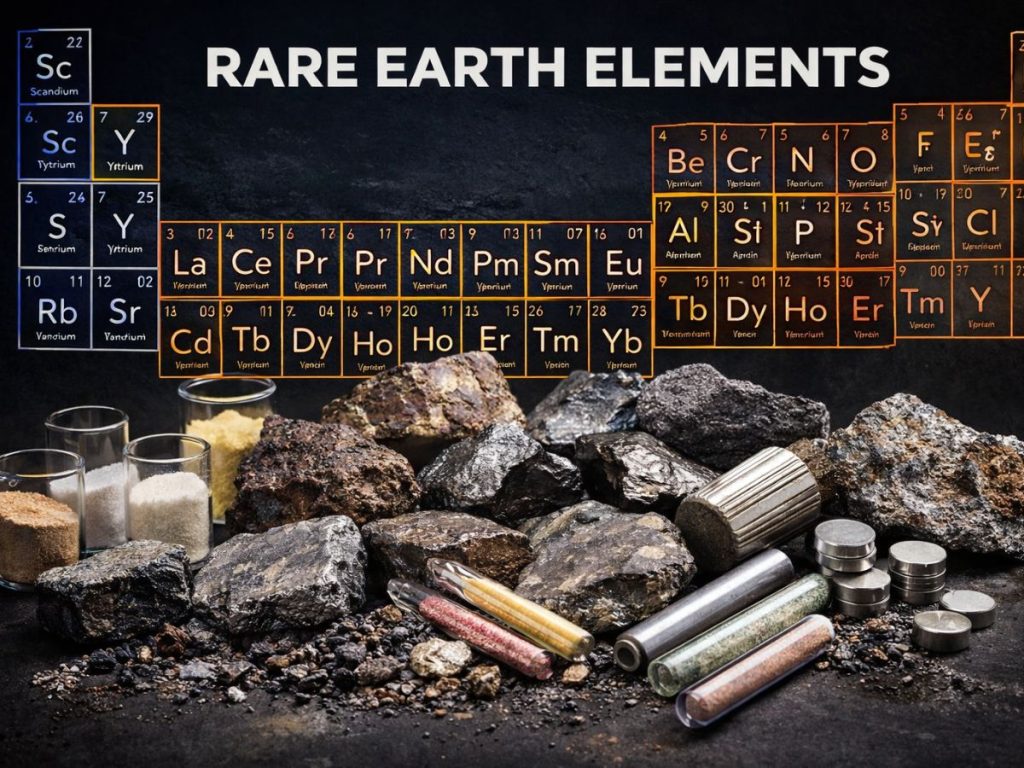
Kendrick Resources Plc has completed more than 100 boreholes at its Teufelskuppe Carbonatite Complex in Namibia, reporting rare earth mineralisation grades of up to 4.62% as the company advances towards establishing a mineral resource estimate.
The company said its latest reverse circulation (RC) drilling results from 11 boreholes, TKRC021 to TKRC031, confirmed continued light rare earth oxide (LREO) mineralisation across significant widths.
The highest reported intercept was 4.62% LREO over 20 metres, while other results included 4.22% over 40 metres and 3.41% over 54 metres.
All 11 boreholes returned mineralised intercepts, strengthening the company’s geological understanding of the project as it prepares to undertake resource estimation and metallurgical testing.
Kendrick Resources Chairman Colin Bird said exploration activities, which commenced in May 2026, had progressed rapidly, with more than 100 boreholes completed to date.
“Physical exploration commenced in May of this year, and we have completed over 100 boreholes and generated the underlying information required to determine a mineral resource and provide bulk samples for metallurgical test work. We will maintain our rate of progress and complete any outstanding logging and sampling as soon as possible so that certified assays can be generated to inform the geological model and resource estimation,” Bird said.
The company said the latest grades were calculated using a 3% LREO cut-off, while assessments at lower cut-off grades of 2.5% and 2% identified wider intervals of continuous mineralisation.
According to Kendrick, the wider mineralised zones could increase the project’s potential resource tonnage, although the company is still assessing the relationship between mineral grades and volumes.
Bird said the discovery of continuous mineralisation across substantial widths at lower cut-off grades provides flexibility in determining the project’s potential resource size.
“The significance of package widths of continuous mineralisation at lower cut-off grades is an exciting discovery and is being assessed in the context of tonnage versus grade. We are fortunate that even our lower grade mineralisation is also positioned in the upper quartile in terms of REE deposits worldwide and therefore we have the flexibility of being able to assess the Bonya resource in terms of grade and tonnage,” he said.
Kendrick is now completing outstanding geological logging and sampling to obtain certified laboratory assay results, which will be used to develop the geological model and calculate a mineral resource estimate.
The company will also undertake metallurgical test work using bulk samples collected during the exploration programme to assess the characteristics of the mineralisation.
Despite the latest drilling results, Kendrick has yet to announce a formal mineral resource estimate, with further technical work required to determine the project’s resource potential.