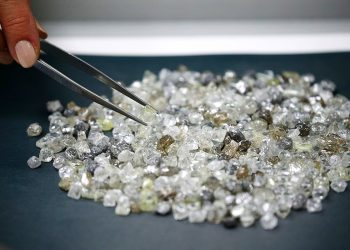
Namibia’s primary and secondary industries contracted during the first quarter of 2026 as weak global demand for diamonds weighed heavily on mining activity and manufacturing output.
According to the latest economic data released by the Namibia Statistics Agency (NSA), primary industries contracted by 5.7%, largely due to a 12.2% decline in the mining and quarrying sector.
Diamond mining, one of the country’s key economic activities, fell by 18.6% amid subdued international demand. Production of metal ores, including gold and zinc, also declined by 31.2%.
“Furthermore, economic activities slowed in the primary industries, recording a decline of 5.7% in real value added compared to a 4.2% decline recorded in the corresponding quarter of 2025. The poor performance is attributed to the mining and quarrying sector, which registered a decline of 12.2% in real value added. The decline in performance is due to the significant reduction in mineral production, mainly in diamond and gold,” said NSA Statistician General Alex Shimuafeni.
Despite the broader downturn in mining, uranium production grew by 14.6%, supported by favourable international prices.
Secondary industries also remained under pressure, contracting by 3.1% during the quarter.
Manufacturing declined by 5.9%, driven by an 87.9% drop in basic metals production and a 35.7% decline in diamond cutting and polishing.
“On the contrary, a downturn was witnessed in the secondary industries, which recorded a decline of 3.1% in real value added during the period under review, compared to growth of 2.4% recorded in the corresponding quarter of 2025. This performance emanates from the manufacturing sector, which registered a 5.9% decline in real value added, compared to a decrease of 1.2% witnessed in the same quarter of 2025,” he said.