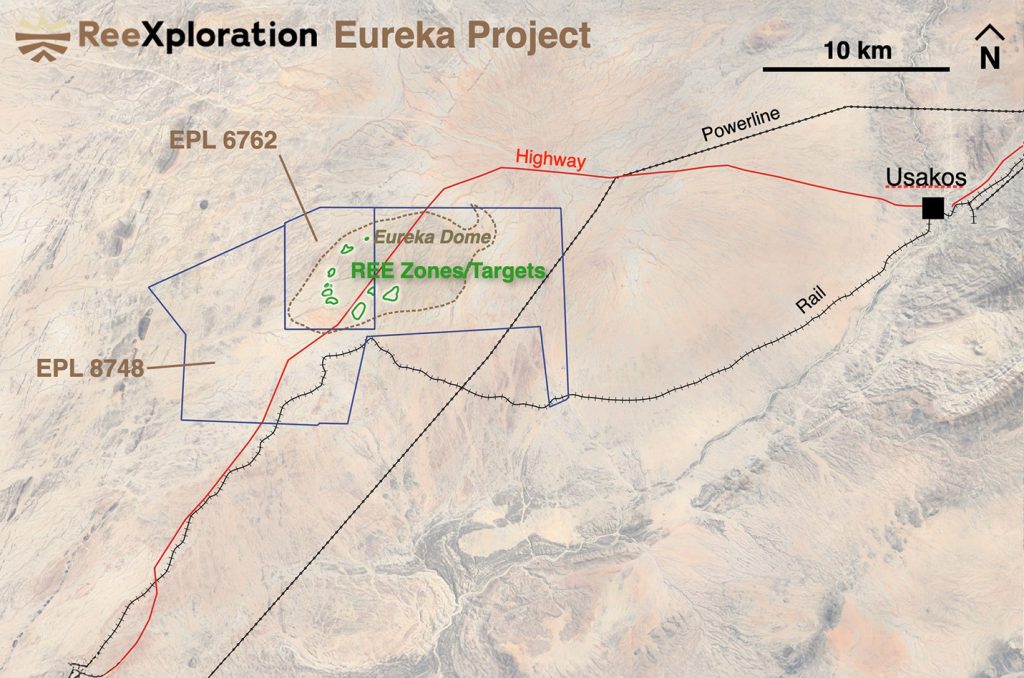
ReeXploration Inc. has reported encouraging preliminary results from its maiden uranium drilling programme at the Eureka Project in central Namibia, confirming widespread radiometric anomalies and favourable geological conditions associated with Rössing-style uranium mineralisation.
The company said its 11-hole, 1,729-metre reconnaissance drilling programme intersected leucogranite units in all holes, a key host rock linked to major uranium deposits in Namibia, including Rössing and Etango.
Elevated radioactivity readings were recorded in five of the 11 holes, reaching up to 640 counts per second (cps), indicating strong uranium potential.
“We are highly encouraged by the results from our first uranium drilling programme at Eureka. The programme has successfully validated our Rössing-style exploration model, confirming the presence of the right rocks in the right structural settings, along with widespread elevated radiometric responses indicating the potential scale of the system,” said Interim Chief Executive Officer Christopher Drysdale.
The company reported that multiple stacked leucogranite bodies were identified across the project area, reinforcing a structural setting favourable for uranium emplacement near the Eureka Dome.
Portable XRF and handheld spectrometer readings further supported the presence of uranium mineralisation within both host rocks and contact zones.
In addition to primary bedrock mineralisation, near-surface uranium occurrences were identified in seven of the 11 drill holes within calcrete and gypcrete horizons. Visible carnotite, a secondary uranium mineral, was also observed, pointing to potential Langer Heinrich-style secondary mineralisation.
Follow-up work will include downhole radiometric surveys, laboratory geochemical analysis and integration of results to refine future drilling targets and improve understanding of mineralisation trends at the Eureka Project.
“Importantly, we are seeing indications of both primary and near-surface uranium mineralisation, highlighting the multi-target potential of the project. We look forward to advancing these results with further downhole radiometrics and geochemical analysis,” Drysdale said.