Ongwe Minerals has launched its maiden drilling programme at the Nguni gold prospect in Namibia, deploying two drill rigs to test a high-grade gold-in-soil anomaly stretching more than six kilometres.
The Nguni prospect forms part of the Omatjete Gold Project and is located about 17km east of Ongwe’s Manga Gold discovery along the Okondeka Fault Zone.
Ongwe Chief Executive Officer Dave Underwood said the company discovered the anomaly in May 2026 during regional soil sampling, with subsequent infill work defining a significant high-grade target.
A total of 50 soil samples from the central portion of the anomaly returned gold values above 300 parts per billion (ppb), with a peak result of 1,310ppb.
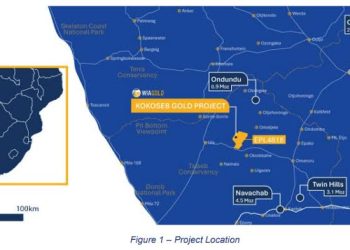
Ongwe said the scale and grade characteristics of the anomaly are comparable to those recorded at the neighbouring Kokoseb gold deposit before drilling began there.
“The central portion of the Nguni gold anomaly has now been closely defined by infill soil sampling, with 50 soil samples above 300ppb Au, peaking at 1,310ppb Au. This represents a 6km long, high-grade soil anomaly similar in scale and tenor to the anomaly at the neighbouring Kokoseb gold deposit, before it was drilled,” Underwood said.
“We are now embarking on the maiden, fully funded drill program at this exciting target.”
The initial programme comprises 18 diamond drill holes totalling about 3,500 metres targeting the highest-grade sections of the anomaly.
A reverse circulation (RC) rig will drill a further 13 holes totalling approximately 1,500 metres across lower-priority targets to assess their grade potential.
Underwood said diamond drilling would provide geological, structural and mineralogical information needed to guide subsequent exploration, while RC drilling provides a faster and cheaper method of testing the wider anomaly.
“A diamond drill rig has been mobilized to test the highest-grade portion of the anomaly so that we can collect detailed geological, structural and mineralogical information upfront, in order to better guide the follow-on drill program,” he said.
“The lower grade central portions of the anomaly will be scout drilled using an RC rig, which provides a quick and relatively cheap method of establishing grade potential and allows for ranking of targets.”
Ongwe is also planning five diamond drill holes totalling 1,000 metres at the eastern extension of the Manga Gold Prospect, about 17km west of Nguni.
The programme will target a bedrock gold anomaly extending for at least one kilometre and remaining open to the east.
Previous drilling at Manga returned anomalous gold values in 10 of 11 RC holes, including an intersection of 138 metres grading 0.22 grams per tonne of gold.
“We are also planning a diamond step-out drill program at Manga over the highest grade and width portion of the bedrock anomaly defined earlier in the year,” Underwood said.
“The priority bedrock anomaly starts east of the previous RC drilling at Manga, stretches for at least 1,000m and is still open to the east.”
The drilling programmes are expected to provide further information on the scale, grade and potential of gold mineralisation at both Nguni and Manga.