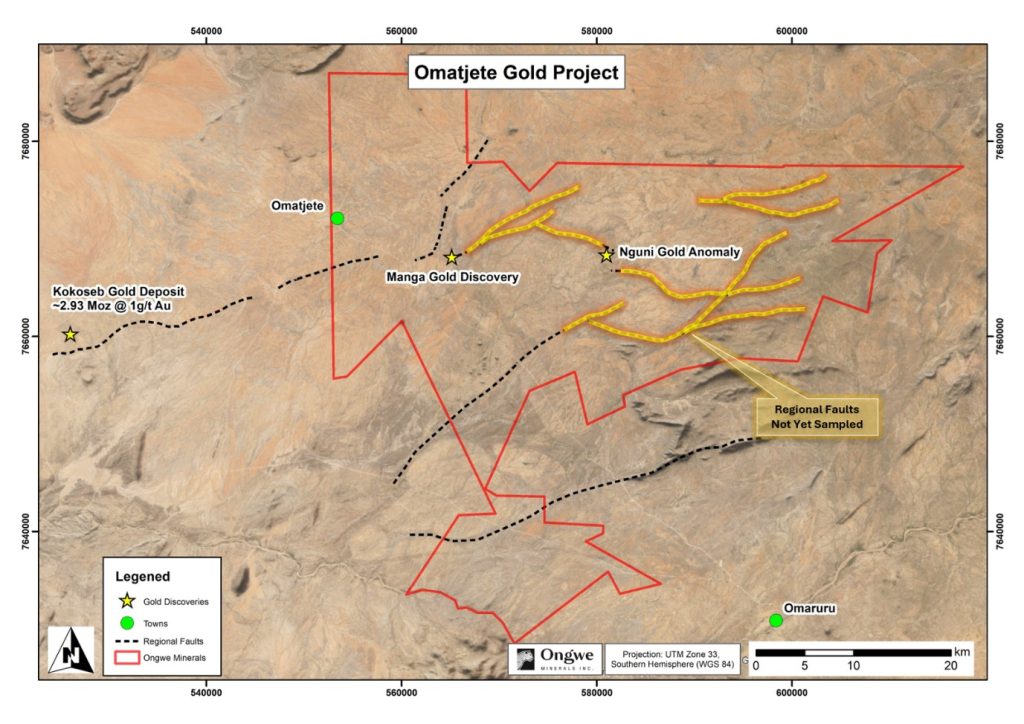
Ongwe Minerals Inc. has identified a 6-kilometre gold-in-soil anomaly at its newly discovered Nguni prospect in Namibia and is preparing to begin a 5,000-metre maiden drilling campaign later this month.
The Canadian-listed exploration company said the Nguni prospect, located about 17 kilometres from its Manga Gold discovery within the Omatjete Gold Project, returned encouraging soil sampling results, including 50 samples exceeding 300 parts per billion (ppb) gold, with the highest assay reaching 1,310ppb gold.
Ongwe Chief Executive Officer Dave Underwood said the results confirm Nguni as a significant exploration target with district-scale potential.
“The infill work on the Nguni prospect is now complete and it looks like a very robust target with scale potential. We are excited about initiating the first-ever drill programme at Nguni and will commence with RC and diamond drilling to obtain detailed geological information in this area of very limited outcrop,” Underwood said.
The company completed an infill soil sampling programme on a 50-metre by 50-metre grid, collecting 1,605 samples across the accessible portion of the prospect.
According to Ongwe, the programme confirmed a continuous gold anomaly extending over a 6km strike length at values above 50ppb gold, with mineralisation remaining open to the north, east and west.
The Nguni prospect was discovered in May 2026 during a regional soil sampling programme targeting the Okondeka Fault Zone, a geological structure that hosts WIA Gold’s Kokoseb Gold Deposit and Ongwe’s Manga Gold discovery.
Underwood said geological mapping and trial pitting indicate that the mineralisation is hosted within metasedimentary rocks adjacent to granite contact zones, a geological setting similar to that at Kokoseb.
Surface investigations also indicate that the prospect is covered by between one and five metres of alluvial scree, with limited bedrock exposure restricted to river cuttings.
The initial drilling programme, scheduled to begin towards the end of August, will focus on the core of the anomaly using both reverse circulation (RC) and diamond drilling to improve the company’s understanding of the area’s geology, structure and stratigraphy.
“We will start off with a single rig and ramp up once we understand the structure and geology a little better. This will also give us time to sample the neighbouring farms, delineate the remainder of the anomaly and incorporate it into the drilling programme,” Underwood said.
Ongwe said it believes the gold-in-soil anomalies are largely in situ, with only limited influence from surface drainage.
The company is also finalising access agreements with neighbouring landowners covering the northern, eastern and western extensions of the anomaly, with approvals expected shortly.
Underwood said additional drilling rigs could be deployed once the geological controls and mineralisation patterns become better defined through the initial phase of exploration.