Namibia has managed to retain Dangote Industries Limited’s US$2.5 billion fuel storage and regional pipeline investment after President Netumbo Nandi-Ndaitwah personally intervened, but lost a proposed N$13 billion drydock shipyard development at Walvis Bay following four years of bureaucratic delays.
Nandi-Ndaitwah revealed that the two projects had encountered administrative obstacles, with the shipyard investors eventually withdrawing while Dangote Industries remained committed to its investment following her intervention.
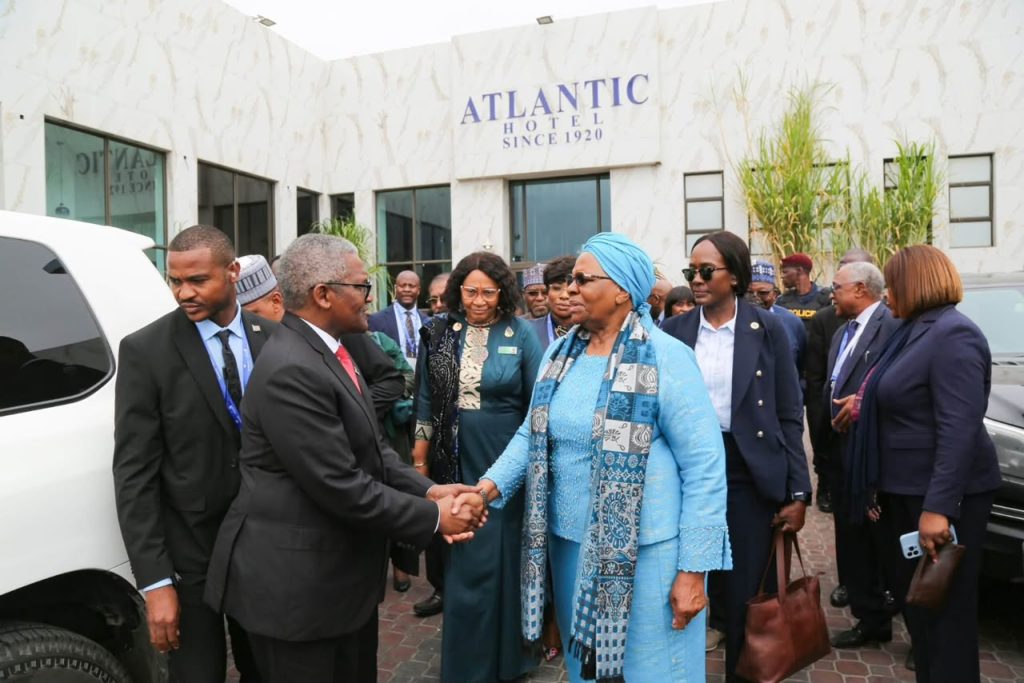
Speaking at the launch of the Dangote Namibia Tank Farm and Regional Pipeline Project in Walvis Bay, the President acknowledged that delays in government processes had nearly cost Namibia the investment.
“I apologise for all the delays you have experienced. At times, the frustrations were such that we could have lost this project,” Nandi-Ndaitwah said.
“When the team was becoming frustrated, I had to call Mr Dangote and plead with him to hold on and give me the opportunity to make it work.”
The President said the difficulties encountered by Dangote highlighted the same administrative challenges that had previously resulted in the withdrawal of investors planning to establish a drydock shipyard at Walvis Bay.
“One of the cases that affected me most was the proposed establishment of a shipyard in Namibia. The investors were serious and wanted to proceed, but after four years, they had to withdraw,” she said.
The proposed shipyard was announced in 2024 by Tridock Shipyard Namibia (Pty) Ltd, which planned to invest up to N$13 billion (US$728 million) in a drydock facility serving the offshore oil and gas, marine mining and commercial shipping sectors.
The project was expected to create up to 1,000 direct jobs and generate approximately N$2.7 billion in annual revenue during its initial years of operation, with projections that revenue could double within three years of commissioning.
The proposed development was planned for a 65-hectare site at Walvis Bay, with construction scheduled to begin in 2026 and operations targeted for 2031.
The facility was designed to accommodate vessels measuring up to 300 metres in length, including offshore oil rigs, dredgers, anchor-handling tugs, platform supply vessels, workboats, crew vessels and large offshore mining vessels.
Nandi-Ndaitwah said the experience of losing the shipyard investment had reinforced the need for direct government oversight of major projects.
She explained that her previous experience dealing with investors as Minister of International Relations and Cooperation had influenced her decision to personally monitor the Dangote investment after assuming the presidency.
The President said she had instructed National Planning Commission Director General Ambassador Kaire Mbuende to coordinate the project and provide regular updates on its progress.
She stressed that government institutions needed to address administrative inefficiencies that were delaying investments and discouraging private-sector participation.
Nandi-Ndaitwah warned that continued bureaucratic delays could result in the loss of further investments and employment opportunities at a time when Namibia was seeking to accelerate economic development.
She said additional major investments were expected and called for stronger coordination between government institutions and private investors to ensure that proposed developments proceeded without unnecessary obstacles.
The President also reaffirmed the government’s commitment to public-private partnerships as a means of supporting infrastructure development, industrialisation and job creation.
The Dangote project involves the development of a 600-million-litre petroleum storage facility and a planned 1,700-kilometre regional pipeline intended to supply fuel markets across southern Africa.
The storage facility will have a capacity equivalent to approximately four million barrels, comprising 360 million litres of diesel and 240 million litres of petrol.
The project will also include truck-loading and dispensing facilities and associated infrastructure to support petroleum storage and distribution.
The proposed pipeline route will extend from Walvis Bay towards Otjiwarongo, with connections northwards towards Rundu and eastwards towards Ghanzi and Francistown in Botswana.
The broader distribution network is expected to serve Botswana, Zambia, Zimbabwe, Malawi and the southern Democratic Republic of Congo.
The investment is intended to position Walvis Bay as a regional petroleum storage and distribution hub serving southern Africa.