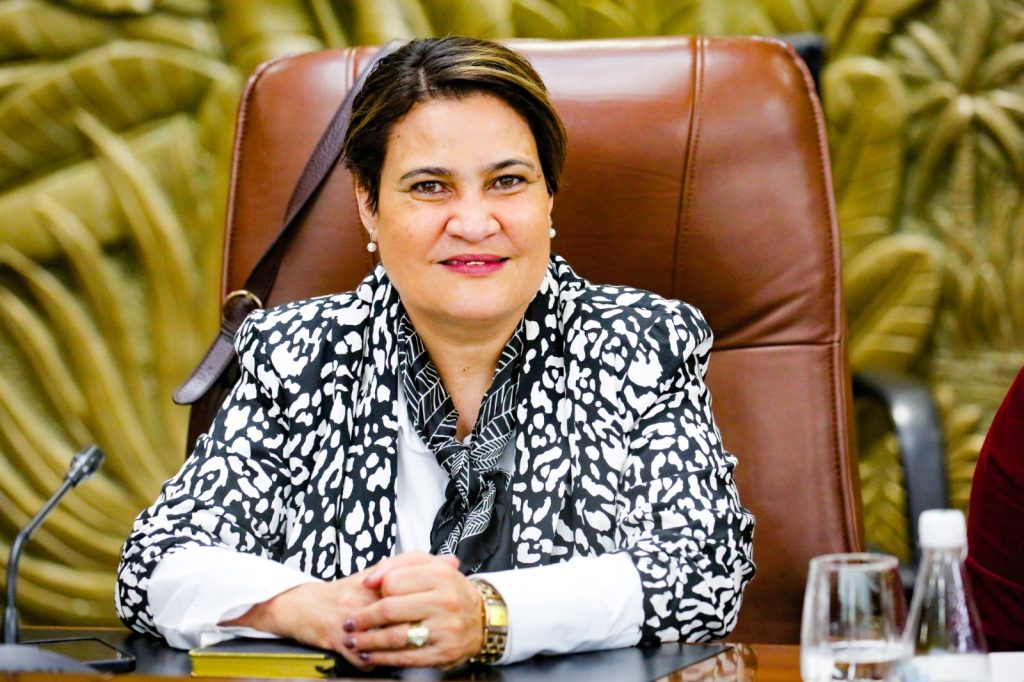
Namibia has not adopted a policy or law requiring 51% local ownership in new mining ventures, Deputy Minister of Industries, Mines and Energy Gaudentia Krohne has said, as the government seeks to reassure investors amid continued uncertainty over future ownership requirements in the sector.
Speaking during a benchmarking and familiarisation visit to India’s Bharat Diamond Bourse, Krohne rejected claims that a 51% Namibian equity requirement represents the government’s current policy position.
She said Namibia remains open to foreign investment and warned that uncertainty over ownership requirements could discourage investors from committing capital to the country.
“That is not the government’s position. Yes, the government wants to reach that level, but currently, we do not have such policies. There is no such law,” Krohne said.
“The government may gradually wish to reach that level, but if any government makes such a statement, you will chase away investors. We are investor-friendly. We would rather invite investors to come and invest and leave their footprints in Namibia.”
Krohne described previous statements on the 51% requirement as an individual political position rather than official government policy.
Her comments come after the government previously indicated that it was considering mechanisms to increase Namibian ownership in new mining projects.
At the 2025 Mining Expo, then Deputy Prime Minister and Minister of Industries, Mines and Energy Natangwe Ithete said the government was considering a 51% Namibian ownership requirement as part of a broader review of the Minerals Bill.
Ithete said consultations were being conducted with the mining industry on mechanisms to increase local ownership, arguing that greater Namibian participation was important for the long-term stability and sustainability of the sector.
The proposal triggered concern among mining companies and investors over how such an ownership requirement could affect existing and planned investments.
In June 2026, Chamber of Mines Chief Executive Officer Fabian Shaanika warned that continued uncertainty over the proposed requirement was making it difficult for some investors to reach final investment decisions.
Shaanika said investors needed clarity on the rules governing future projects, regardless of whether the eventual local ownership requirement was set at 51%, 18% or another level.
He called on the government to conclude consultations and clearly communicate its final position to the market.
The debate has already had an impact on investor sentiment. Following the initial 51% proposal in 2025, some foreign-listed mining companies with Namibian interests temporarily suspended trading as markets sought clarity on the potential implications.
President Netumbo Nandi-Ndaitwah subsequently reassured investors that the proposed 51% local ownership requirement did not constitute an adopted government policy.
Krohne’s latest comments reinforce that position, while acknowledging that the government ultimately wants to increase Namibian participation in the mining industry.
The issue remains under discussion as Namibia seeks to balance greater local ownership and economic participation with maintaining its attractiveness to international mining investors.