Golden Deeps Ltd (ASX: GED) has commenced a major diamond drilling programme at its Graceland Critical Metals Prospect in Namibia’s Otavi Mountain Land Metallogenic Belt, targeting high-grade polymetallic sulphide mineralisation containing copper, silver, zinc, lead, germanium and antimony.
The drilling campaign follows exceptional historical sampling and shallow drilling results that highlight the prospect’s potential to host a significant Tsumeb-style mineral system.
According to Chief Executive Officer Jon Dugdale, channel sampling at the Gossan 1 target returned outstanding grades of 3 metres at 11.2% copper, 294 grams per tonne (g/t) silver and 8.7% zinc, including a 0.5-metre interval grading 31.7% copper, 961 g/t silver, 15.3% zinc and 79 g/t germanium.
At the nearby Gossan 1 East target, sampling returned 3.5 metres at 12.6% copper, 79 g/t silver and 403 g/t antimony, including a 1-metre interval grading 20.1% copper, 176 g/t silver and 1,205 g/t antimony.
“We are delighted to have secured a diamond drilling rig capable of testing the high-priority ‘Tsumeb-type’ targets within the Gossan 1 highly mineralised corridor at the company’s Graceland Prospect. This drilling will follow up on the spectacular high-grade rock chip, channel sampling and shallow drilling results already received to date,” Dugdale said.
He said previous shallow diamond drilling beneath the gossan zones had also intersected significant mineralisation, including 3.48 metres grading 7.6% copper equivalent and 1.82 metres grading 16.6% copper equivalent.
The current programme will initially comprise 10 diamond drill holes targeting two induced polarisation (IP) chargeability anomalies located down-plunge and east of the Gossan 1 and Gossan 1 East zones. The first phase will test mineralisation within the top 100 metres, followed by deeper drilling to investigate extensions below that depth.
The company will also test the Gossan 1 Far East IP target, the strongest geophysical anomaly identified at Graceland, despite it having no surface expression.
“This new diamond drilling will initially test sulphide target zones below and down-plunge of the Gossan 1 and Gossan 1 East very high-grade mineralised zones, where the results of the company’s IP geophysical survey have highlighted potential sulphide deposits in a similar setting and geometry to the world-class Tsumeb deposit, just 30 kilometres to the north,” Dugdale said.
Golden Deeps said recent shallow drilling has already intersected encouraging zones of mineralisation. Drill hole GLBPD009, the deepest completed to date, intersected an 8.8-metre strongly mineralised zone containing sphalerite, galena and malachite.
Other drill holes also intersected oxidised dolomite zones containing copper mineralisation, including GLBPD006, which intersected 4.5 metres of malachite and azurite mineralisation, and GLBPD007, which intersected a 5-metre zone containing malachite stringers.
The company said Graceland shares geological similarities with the world-class Tsumeb deposit, located about 30 kilometres north of the project. The deposit historically produced 27 million tonnes grading 4.3% copper, 10% lead, 3.5% zinc, 95 g/t silver and 50 g/t germanium.
The Graceland mineralised corridor extends over an 800-metre strike length within a broader 3-kilometre northeast-southwest corridor. Golden Deeps has identified three major IP chargeability anomalies that could represent Tsumeb-style sulphide targets, with mineralisation remaining open to the east and at depth.
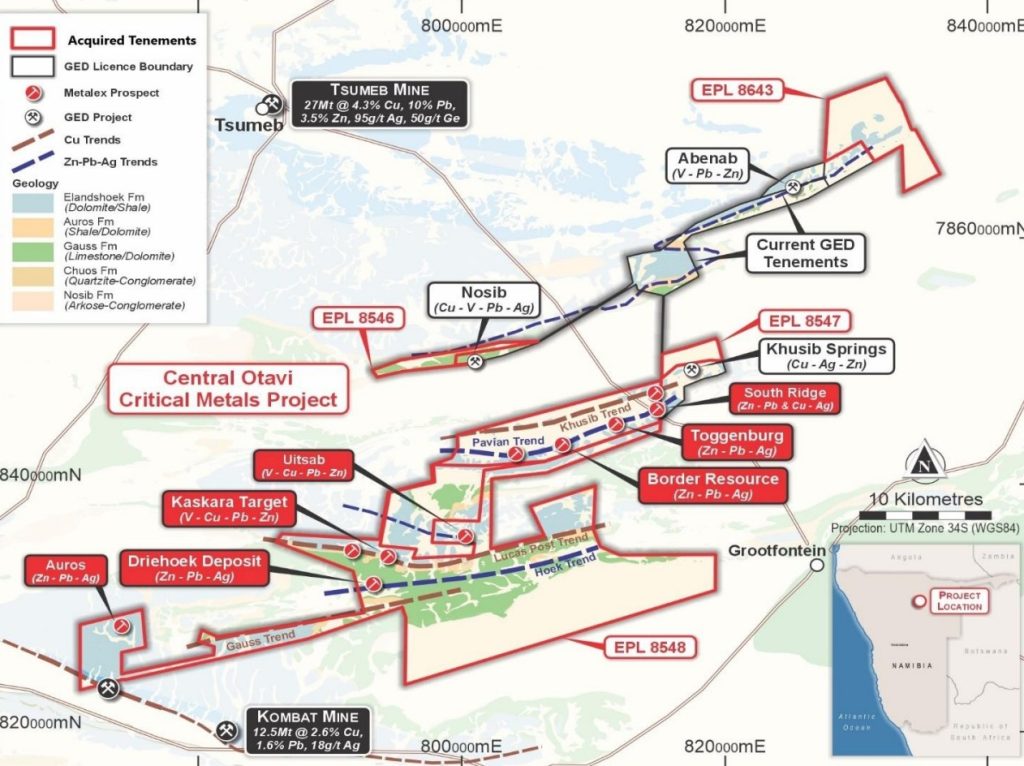
Beyond Graceland, Golden Deeps holds a portfolio of advanced exploration assets across Namibia’s Otavi Mountain Land, including projects hosting resources of vanadium, copper, lead, silver, zinc and gallium.