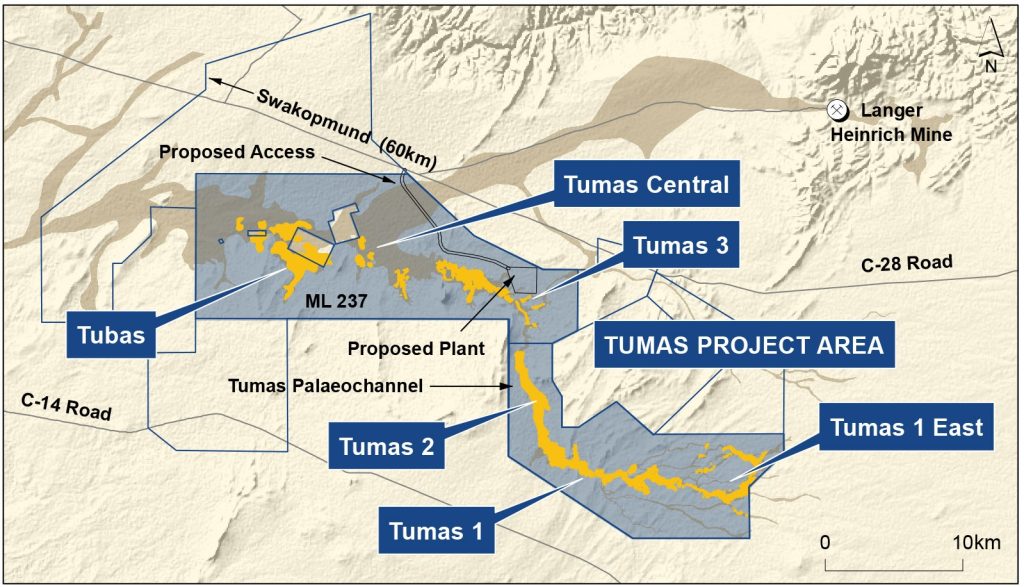
Deep Yellow’s Tumas uranium project in Namibia is advancing steadily, supported by an initial capital investment of approximately N$7.55 billion, as the company progresses development while awaiting favourable uranium market conditions.
According to the company’s corporate update, the project carries a post-tax Net Present Value (NPV8) of N$9.19 billion (US$577 million), with a projected post-tax Internal Rate of Return (IRR) of 19%, underscoring its long-term economic viability.
Operating efficiency is expected to be supported by an All-In Sustaining Cost (AISC) of N$716.40 (US$45) per pound of U₃O₈, positioning the project competitively within the global uranium market.
“The post-tax Net Present Value (NPV8) of the project is estimated at US$577 million. The post-tax Internal Rate of Return (IRR) is projected at 19%. Initial capital expenditure is estimated at US$474 million. The All-In Sustaining Cost (AISC) is projected at US$45 per pound of U₃O₈,” the company said in its report.
Deep Yellow also announced a strategic deferral of the Final Investment Decision (FID) for the flagship Tumas Project. Despite the project being execution-ready and fully permitted, the company said the FID will only be declared once uranium prices provide sufficient incentive to maximise shareholder value and capture upside from improving market conditions.
By delaying the decision, the company aims to avoid locking in contracts at lower prices and instead bring production into a market expected to reach a significant inflection point driven by growing structural supply deficits.
“FID awaiting sufficient uranium price incentivisation for greenfield project development,” the report noted.
While the investment decision is being carefully timed, technical work on the ground continues to de-risk the project. Detailed engineering is more than 65% complete, and over 70% of major equipment packages have already been tendered to enable rapid execution once the FID is approved.
Infrastructure development is also progressing, supported by an executed power supply agreement and ongoing work to secure a long-term water supply. More than 65% of bulk earthworks have been completed.
The Tumas Project has a projected mine life of 30 years and is expected to produce approximately 3.6 million pounds of uranium annually once operational.