The Dâures Green Fertiliser Project has secured up to US$3.6 million in new development funding as it moves towards a commercial-scale facility capable of producing 80,000 tonnes of ammonium sulphate fertiliser annually in Namibia.
SDG Namibia One, part of Climate Fund Managers’ Climate Investor Three Fund, has signed a Development Funding Agreement with Enersense Energy Namibia to advance the Erongo-based project towards bankability.
The US$3.6 million commitment forms part of a development budget of up to US$7.07 million, with SDG Namibia One joining Enersense Energy Namibia as a co-developer.
The funding will support front-end engineering design, market development, permitting, environmental and social studies and efforts to convert market interest into bankable offtake agreements.
The investment comes as the project targets production of Namibia’s first locally manufactured green fertiliser from its pilot operations by the fourth quarter of 2026.
About US$17.7 million has already been mobilised for pilot and proof-of-concept activities through funding from the German Federal Ministry of Education and Research, the United Nations Industrial Development Organisation (UNIDO), the United Kingdom Government and Enersense.
Operational data generated from the pilot will be used to inform the design and optimisation of the planned commercial-scale development.
Namibia Hydrogen Fund Managers Chief Executive Officer Mercia Geises said the latest funding is intended to help move the project towards bankability and ultimately attract private capital at a larger scale.
“Through SDG Namibia One, we are providing the early-stage development capital and co-development support needed to progress the project towards bankability and create the conditions for private capital to invest at scale,” Geises said.
She said the project could also support Namibia’s green industrialisation ambitions by converting locally produced green hydrogen into an agricultural input instead of limiting renewable energy development to primary energy production.
“The Dâures Green Fertiliser Project aligns strongly with Namibia’s green industrialisation ambitions, creating greater value from the country’s renewable resources by using green hydrogen to produce a critical agricultural input at home,” Geises said.
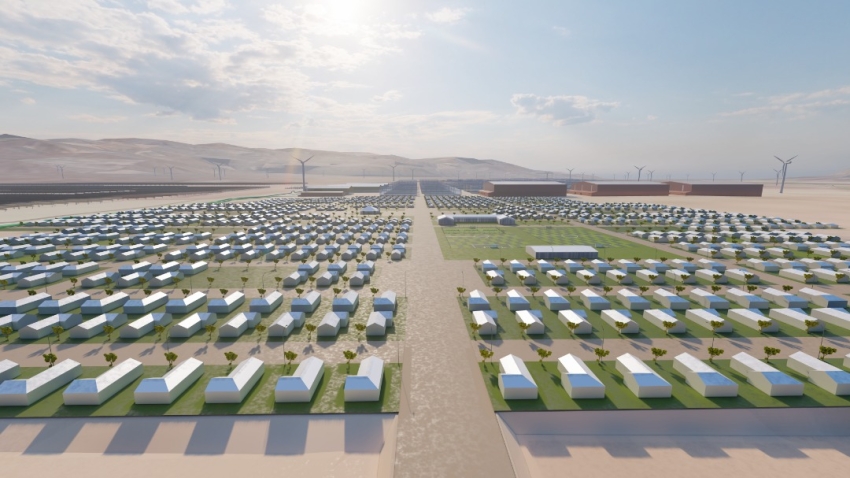
The proposed commercial facility, located in the Dâures Constituency about 50 kilometres inland from the Atlantic coast, is targeting annual production of up to 20,000 tonnes of green ammonia and 80,000 tonnes of ammonium sulphate fertiliser.
It is planned to incorporate 60 megawatts (MW) of solar photovoltaic capacity, 10MW of wind generation and a 65 megawatt-hour battery energy storage system.
The renewable electricity will power a 40MW electrolysis facility to produce green hydrogen, which will subsequently be converted into green ammonia and fertiliser.
Daures Fertilizer Solutions Interim Chief Executive Officer Martin Nambundunga said the development is aimed at reducing Namibia’s dependence on imported fertiliser and improving access to agricultural inputs.
“A country cannot truly be independent if it cannot feed its own people, and our farmers cannot produce enough food if we continue depending on expensive fertiliser imports,” Nambundunga said.
“Our goal is simple: manufacture these inputs locally to make them accessible to farmers in Namibia and beyond, create jobs, support local industries with cleaner products, and improve livelihoods.”
The project is also targeting regional markets as Namibia and the wider Southern African Development Community remain heavily dependent on imported fertiliser.
Once operational, the commercial facility is expected to avoid approximately 48,000 tonnes of carbon dioxide equivalent emissions annually and create up to 115 permanent jobs.
European Commission Director for the Green Deal and Digital Agenda at the Directorate-General for International Partnerships Erica Gerretsen said the project demonstrates how green hydrogen development could be linked to agriculture and food security.
“By using renewable energy to produce green fertiliser locally, Namibia can reduce its dependence on imports, strengthen the resilience of its agricultural sector and create new opportunities for farmers, businesses and rural communities,” Gerretsen said.
Invest International Chief Investment Officer Jeroen Plag said green hydrogen could also contribute to decarbonising hard-to-abate industries, including fertiliser production.
The latest development funding is being provided by the European Union under its Global Gateway strategy and Invest International.
Financial close for the commercial-scale development is targeted for the second quarter of 2028, with commercial operations expected to begin in the first quarter of 2030.
SDG Namibia One is managed by Namibia Hydrogen Fund Managers, a partnership between Climate Fund Managers, Invest International and the Environmental Investment Fund of Namibia.
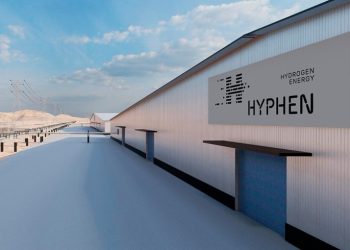
The Dâures Green Fertiliser Project is the fund’s fourth investment, following Hyphen, HyIron’s Oshivela Project and the Zhero Molecules Walvis Bay Project.