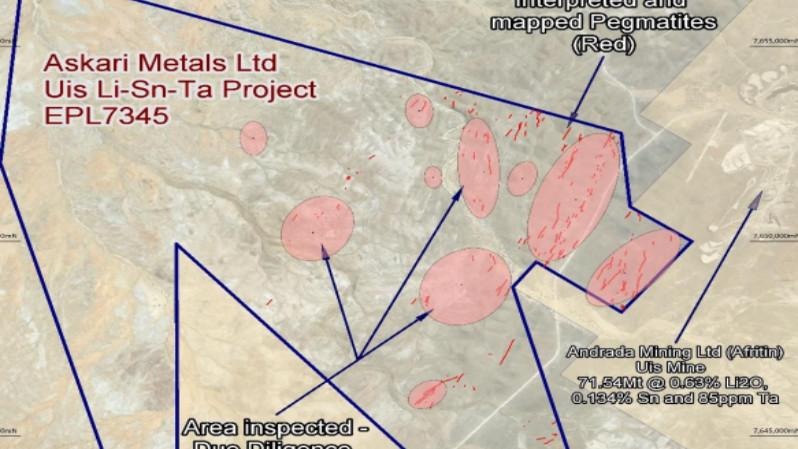
Askari Metals Limited has expanded its exploration footprint at its wholly owned Uis Project in Namibia, identifying seven new high-priority pegmatite targets ahead of its next phase of reverse circulation (RC) drilling.
The targets were defined through an advanced in-house remote sensing hyperspectral study that integrated Sentinel-2 multispectral data with high-resolution Maxar WorldView-3 imagery.
The approach enabled the company to enhance colour contrasts and more effectively delineate granitic pegmatites from surrounding host rocks across its licence areas.
“This study marks another important step in unlocking the scale and polymetallic potential of Uis. Our in-house hyperspectral work has now delivered seven new high-priority pegmatite targets, materially expanding the project’s pipeline ahead of the next phase of RC drilling,” said Executive Director Gino D’Anna.
The newly identified target inventory includes four prospects on EPL 7345 (Eve, GP, MW and K10) and three on EPL 8535 (Tawny, Martial and Zebedeus-1). All seven targets are located within a previously defined 15-kilometre-long prospective corridor of interest.
Several large-scale structures stand out among the new targets, led by K10 with an interpreted strike length of 3.1 kilometres, followed by GP at 2.4 kilometres and Tawny at 2.2 kilometres.
According to D’Anna, the project is increasingly emerging as a polymetallic opportunity with exposure to key electrification and energy security commodities, including lithium, tin, tantalum, rubidium and caesium.
To accelerate exploration activities, the company has commissioned its own pellet press and handheld Laser-Induced Breakdown Spectroscopy (LIBS) units on site at Uis.
By moving sample preparation and analysis into the field, the exploration team can analyse light elements such as lithium and beryllium in near real time, significantly reducing assay turnaround times and enabling faster exploration decisions.
“Uis is continuing to emerge as a highly strategic polymetallic project with exposure to tin, tantalum, lithium, rubidium and caesium at a time when supply dynamics and growing demand for critical minerals are sharpening investor focus on quality exploration stories,” he said.
Detailed mapping and rock-chip sampling are already underway to rapidly advance the new targets towards trenching. Askari has also planned regional soil and stream sediment geochemical campaigns to test the broader corridor for additional concealed pegmatites.
The incoming data will guide the design of a Phase 1 trenching programme on EPL 8535 and a Phase 2 trenching programme on EPL 7345.
These workstreams are expected to culminate in an initial RC drilling campaign scheduled to begin next quarter, targeting the DP, OP, PS and K9 pegmatites on EPL 7345.
“With field programmes active on the ground, RC drilling set to commence next quarter on the DP, OP, PS and K9 pegmatite targets, and further trenching planned to expand the broader pipeline, we see a strong stack of near-term catalysts at Uis that we believe can continue to build momentum and unlock value,” D’Anna said.