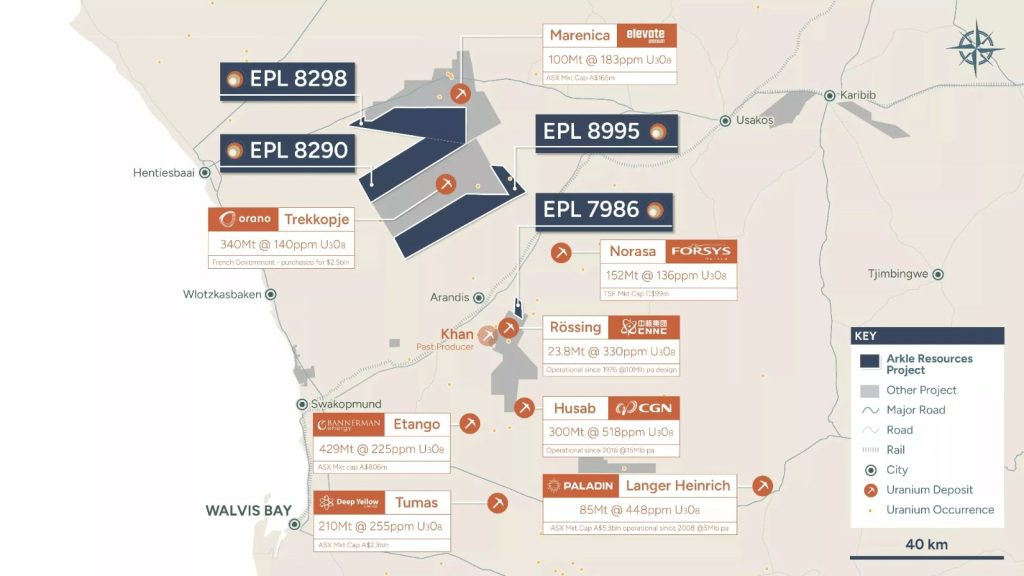
Uranium Project in Namibia, with uranium identified in trenching and historical drillholes as the company prepares to launch its maiden drilling programme.
The London-listed explorer said geological mapping, trenching and downhole surveys are progressing on schedule across its exploration licences in the Erongo Region.
A downhole gamma-ray survey of 106 legacy drillholes identified 16 intercepts exceeding 50 parts per million (ppm) equivalent uranium oxide (eU₃O₈) over one metre or more. Seven of those holes returned grades above 100 ppm, including peak intercepts of 303 ppm over one metre and 215 ppm over two metres.
“We are now firmly into the field, and the early signs from the ground are encouraging. Within weeks of completing the Phase 1 interpretation, our team in Namibia has trenches open across the centre-north leucogranite target on EPL 8995 and has exposed exactly the style of stacked leucogranite sheets we hoped to see, along with carnotite in the fractures, which is a clear visual marker of uranium. Grades will be confirmed by laboratory assay, and the first samples are already with the laboratory,” Chief Executive Officer Rory Harding said.
The company has also excavated seven trenches across a one-kilometre by 700-metre target area, exposing multiple uranium-bearing leucogranite sheets.
Secondary uranium minerals, including carnotite, were identified in rock fractures, while field radiometric readings indicated the presence of uranium. Laboratory assays are pending to confirm the grades.
Harding said geological mapping is also helping refine existing data and improve understanding of the area’s uranium-bearing geological formations, which share similarities with those hosting Namibia’s world-renowned Rössing and Husab uranium mines.
The company plans to begin an initial 1,500-metre reverse circulation drilling programme, comprising approximately 42 drillholes, at the end of June. The campaign will target radiometric anomalies identified through historical drilling and recent exploration work.
“The completed downhole gamma-ray survey of the legacy drillholes across EPLs 8995 and 8298 complements our surface and airborne geophysics and has given us real subsurface confidence. Several legacy holes in the eastern palaeochannel target returned narrow but encouraging uranium intercepts that are directly guiding the design of our first 1,500-metre drill programme. On the central-east channel, the survey points to broader mineralisation, with more than 100 ppm eU₃O₈ indicated across 9.4 metres. These are radiometric indications rather than laboratory assays, but they guide us where to drill,” he said.
He said that, subject to the outcome of trench sampling, Arkle intends to undertake a further fully funded 2,500-metre drilling programme later in the third quarter of 2026, bringing the total planned drilling to around 4,000 metres across its key uranium targets.
“This is the start of a sustained, fully funded drilling campaign of around 4,000 metres across both of our principal uranium styles, with multiple further targets behind it. Shareholders should expect steady news flow through the second half of the year as assays return and drilling gets underway,” Harding said.