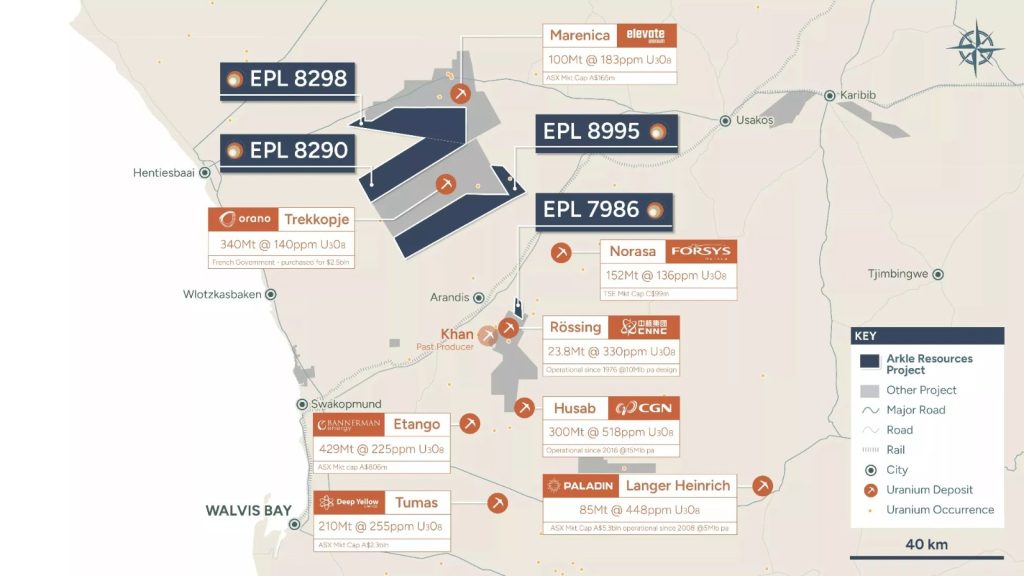
Arkle Resources expects to receive the first laboratory assay results from its maiden drilling programme at the Erongo Uranium Project in Namibia in early September after expanding the campaign to test additional uranium targets, Chief Executive Officer Rory Harding said.
The company has increased the scope of its initial 1,500-metre reverse circulation drilling programme to include step-out holes on the eastern palaeochannel target, a first drill fence across the western palaeochannel target and an earlier-than-planned test of its primary ULG target.
“Grades will be confirmed by laboratory analysis, and shareholders should expect a steady news flow through the second half of the year as results come through,” Harding said.
Arkle said 52 holes had been completed for a total of 1,017 metres across interpreted palaeochannel positions within Exclusive Prospecting Licence 8995.
During drilling, the company visually identified carnotite, a secondary uranium mineral, in drill chips from three holes across two fence lines at depths ranging from four to 15 metres. Laboratory analysis will be required to determine the uranium grades.
“Carnotite, the uranium mineral that carries the grade at the surficial uranium deposits of the region, has been visually logged in drill chips in three holes across two fence lines,” Harding said.
The company said it expanded the drilling programme after achieving operational efficiencies with the current rig and field team, allowing additional targets to be tested within the funded campaign.
“Our maiden uranium drilling programme in Namibia is proceeding as planned and, considering the efficiencies of continuing with the current rig and field team already mobilised, we have decided to expand it,” Harding said.
Arkle has completed the first fence of holes across the western palaeochannel target identified through horizontal loop electromagnetic surveys, while further drilling is planned to extend testing along the eastern palaeochannel.
The company has also brought forward five reconnaissance drill holes on its primary ULG target after recent trenching exposed the target at surface.
“We are also planning step-out holes from the existing fence lines on the eastern palaeochannel target, and we are bringing forward drill holes on our primary ULG target from the next programme into this one. That gives us a first drill test of both of our principal uranium styles within a single field season,” Harding said.
Downhole gamma-ray spectrometer surveys are underway to identify intervals for laboratory testing. Arkle said more than 1,000 one-metre samples had been collected under its quality assurance protocols, with selected samples to be analysed at Actlabs in Windhoek.