Arkle Resources PLC has said it will not participate in the next funding phase of the Stonepark Zinc Project in Ireland, opting instead to focus its exploration capital on uranium assets in Namibia.
The company said that while Stonepark is Ireland’s second-largest undeveloped zinc resource, it is prioritising its “transformative” uranium licences in Namibia.
As a result of its decision not to take part in the current funding round, Arkle’s stake in the project is expected to decline from 22.36% to about 21.38%.
“In prioritising current exploration capital towards the company’s Namibia uranium projects, Arkle has elected not to participate in funding this phase of Stonepark drilling. As a result, Arkle’s interest in Stonepark is estimated to decrease fractionally from 22.36% to 21.38%, subject to final costs after fieldwork completion. Arkle retains the option to participate financially in the remainder of the drilling programme to maintain its equity position,” the company said.
The announcement follows the completion of airborne and ground-based geophysical surveys across Arkle’s uranium projects in Namibia’s Erongo Region earlier this month.
The work forms part of Phase 1 of the company’s exploration programme after it acquired four exploration licences covering 540km² in January 2026.
The surveys, carried out by Xcalibur Smart Mapping and Terratec Geophysical Services Namibia, included a horizontal loop electromagnetic (HLEM) survey as well as magnetic and radiometric airborne mapping covering more than 12,000 line kilometres.
The high-resolution data, four times denser than historical datasets from the 1970s, confirmed a well-developed palaeochannel in the north-east of EPL 8995 and identified a previously unknown palaeochannel in the centre of the licence, with depths of up to 17 metres.
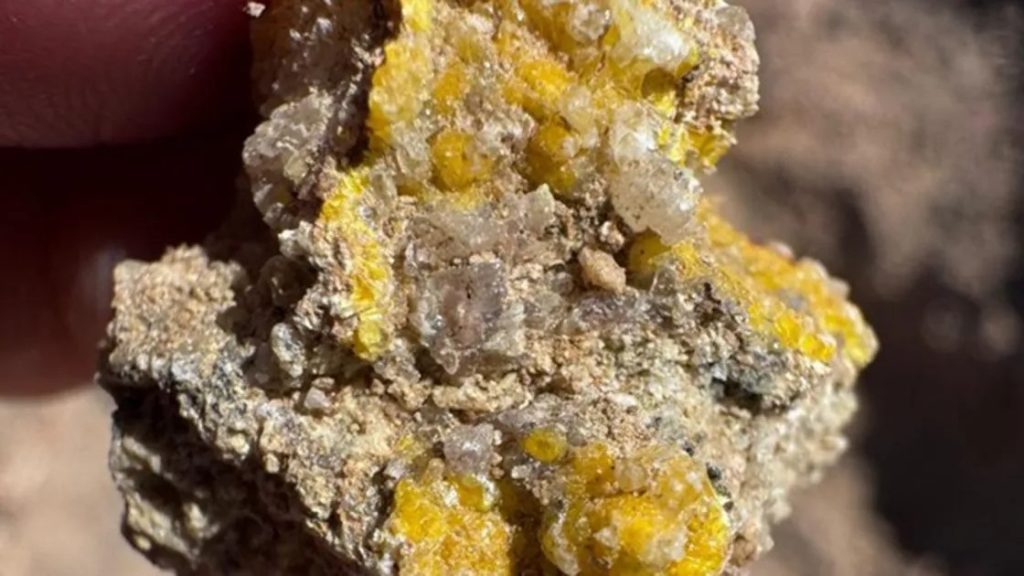
A review of historical drilling also identified 95 open drill holes suitable for downhole gamma logging. These findings, together with results from a 2025 sampling programme that recorded surface uranium values of up to 3,855 ppm U₃O₈, will inform follow-up mapping, sampling and the definition of drill targets.
Arkle plans to undertake up to 4,000 metres of reverse circulation drilling in the second half of 2026.
The company said the results support the advancement of its Namibia uranium portfolio, located in a region that has produced more than 350 million pounds of U₃O₈ over the past 45 years.
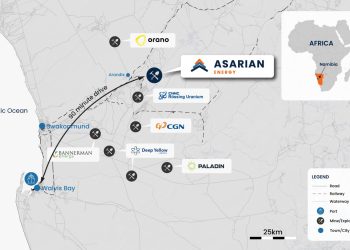
Arkle’s licences are situated near major uranium operations including Trekkopje, Marenica and Rössing, positioning the company within one of Africa’s most established uranium-producing regions.