By Cons Karamata
As one of Africa’s most anticipated offshore oil frontiers, Namibia stands at a historic moment in its economic journey.
The excitement around the Orange Basin discoveries—estimated at billions of barrels of oil equivalent—has returned after a brief lull caused by technical reassessments by operators.
A Final Investment Decision (FID), contingent upon mutually beneficial long-term guarantees, now appears increasingly likely.
Yet, beneath the optimism lies a pressing and uncomfortable question we must confront honestly: is Namibia truly ready for oil?
This is not a question for industry alone. It is a question for Parliament, policymakers, businesses, training institutions, and ordinary Namibians alike. The danger today is complacency—the mistaken belief that we have “ten years” before oil matters. That assumption is profoundly flawed.
Once an FID is announced, the oil project immediately enters the construction phase, a period lasting six to eight years, during which economic activity surges sharply. This is not a distant future event. It is the window in which most jobs are created, most contracts are awarded, and most opportunities are either captured—or lost.
According to the Oil and Gas Industrial Baseline Survey for Namibia conducted by Deloitte, a single deep-water FPSO development could generate around 5,000 jobs during the construction phase, including 500 direct, 2,000 indirect, and 2,500 induced jobs. These jobs are not confined to engineers on rigs; they span transport, construction, catering, logistics, security, retail, ICT, civil works, and professional services.
Crucially, international experience shows that well over two-thirds of in-country economic value in upstream oil and gas typically comes from services, not from oil extraction itself. This means that Namibia’s small and medium enterprises (SMEs) are the real front line of oil-led development. But are they ready?
The baseline survey paints a sobering picture. While over 80% of local companies express strong interest in participating in oil and gas, many lack the certification, working capital, skilled personnel, and Health, Safety, Security and Environmental (HSSE) systems required to meet international standards. Only 14% conduct annual HSSE reporting, and fewer than a third have robust monitoring systems in place . In oil and gas, these are not negotiable extras—they are entry tickets.
The construction phase also demands a vast range of products and services: construction and installation yards, bulk construction materials, cement, steel fabrication, mechanical installation, waste management, warehousing, transport fleets, accommodation, catering, medical services, drilling support, port and marine logistics, power generation, and inspection and certification services. Many of these are already present in Namibia—but not yet aligned to oil-and-gas standards.
The workforce challenge is equally urgent. While Namibia has strengths in civil construction, logistics, hospitality, and general engineering, there are acute shortages in petroleum engineering, offshore welding, pipefitting, industrial process operations, diving certification, and oil-specific HSSE skills . Without deliberate intervention now, high-value roles will inevitably be filled from abroad.
Recognising this risk, and drawing lessons from other oil-producing countries, there is a need to complement ongoing efforts by Government and the industry through more structured engagement with operators on future skills requirements; undertaking a national oil and gas skills audit; establishing a centralised skills database; creating a comprehensive register of local service providers; and targeted SME mentorship programmes. These are practical and achievable steps—but only if they are pursued with urgency.
Parliament’s recent view that petroleum reforms are “not urgent” reflects a misunderstanding of how oil economies develop. Other countries learned—often painfully—that delay in institutional readiness weakens local participation and entrenches dependency. Namibia still has the advantage of timing. But that advantage is rapidly diminishing.
For a project of this magnitude, both Government and investors require appropriate safeguards. Investors naturally seek clarity and predictability for long-term capital commitments, while Government equally needs assurance that its policy space, national interests, and developmental objectives will be protected throughout the project’s lifespan. Establishing these mutual guarantees is a necessary foundation for a stable, trusted partnership as the country prepares for FID.
Oil will not wait for us to be ready. If we do not put our legislative frameworks, governance structures, SME support systems, skills pipelines, and certification pathways in place now, we will simply watch history unfold from the sidelines.
This is our moment to put our house in order. The cost of delay will not be measured in missed debates—but in missed generations of opportunity. The time to act is now.
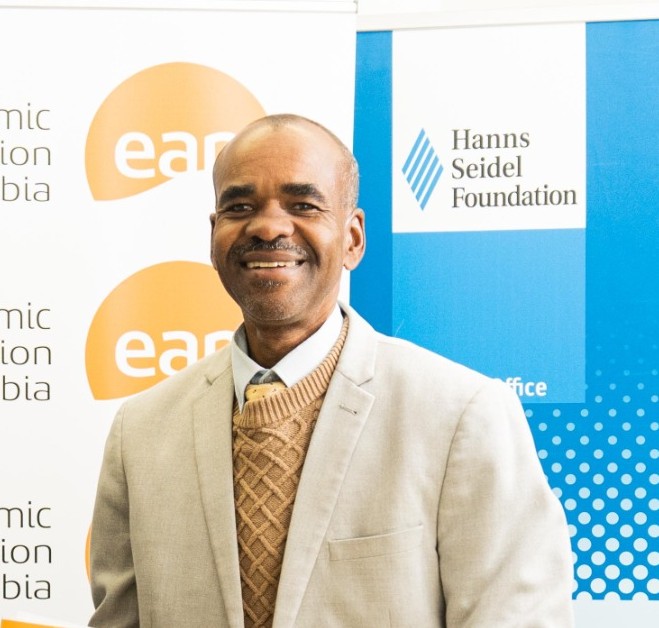
*Cons Karamata is Chief Executive of the Economic Association of Namibia. The Economic Association of Namibia is the organiser of the annual Namibia Oil and Gas Conference (NOGC).