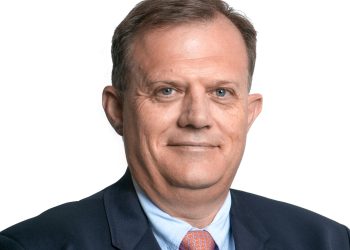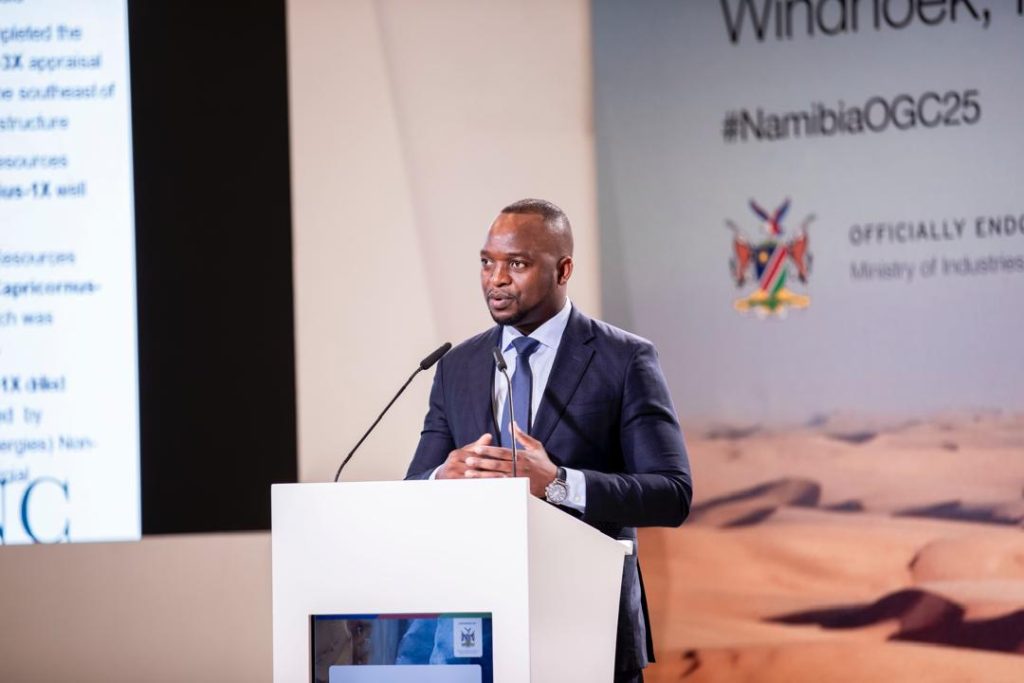
Namibia must accelerate legal and institutional reforms to turn its recent oil and gas discoveries into lasting economic benefits, SNC Managing Partner and President of the Association of International Energy Negotiators (AIEN), Shakwa Nyambe, told delegates at the third Namibia Oil and Gas Conference in Windhoek.
Delivering a presentation titled Industry Leaders’ Insights under the theme From Exploration to Action: Positioning Namibia as the Next Energy Frontier, Nyambe traced the country’s journey from decades of modest exploration results to the transformative breakthroughs of 2022.
“Until 2022, Namibia’s oil and gas history was defined by dry wells and unrealised potential. That changed with Shell’s Graff discovery and TotalEnergies’ Venus find, which have spurred unprecedented exploration activity,” he said.
Since then, 13 deepwater wells have been drilled, yielding 10 discoveries, including the commercial Venus and Mopane fields. “We are now at a pivotal moment for Namibia’s hydrocarbon sector,” Nyambe told the gathering at the Mercure Hotel.
Namibia’s offshore acreage covers about 220,000 square kilometres, held by a mix of international majors, national oil companies, and independents. NAMCOR holds a 10–15% stake in most petroleum blocks, with the option to increase participation before production.
Citing Wood Mackenzie data, Nyambe said Galp Energia holds the largest recoverable resources at 1.644 billion barrels of oil equivalent (boe), followed by QatarEnergy with 1.327 billion boe and TotalEnergies with 1.117 billion boe. “This resource base puts Namibia in the league of emerging global deepwater players, comparable to Guyana and Senegal in their early phases,” he said.
Venus and Mopane are currently the only discoveries with active development plans. TotalEnergies is expected to reach a final investment decision (FID) on Venus in late 2026, while Galp will set a date for Mopane post-appraisal. BW Energy’s Kudu gas field FID is also anticipated in late 2026.
Nyambe stressed that to maintain momentum, Namibia must act quickly on a series of reforms.
“We must fast-track the establishment of an independent Upstream Petroleum Unit to oversee exploration and production activities. This requires amendments to the Petroleum Exploration and Production Act,” he said.
He called for an urgent review of the upstream petroleum legal framework, finalisation of the local content legal framework, and the hiring of consultants, lawyers and advisers to expedite these reforms. “Adequate budget must be allocated to ensure these reforms are delivered without delay,” Nyambe said.
He added that local content provisions should accelerate the participation of indigenous companies in the sector, with regulations including monitoring, evaluation and enforcement mechanisms, and sanctions for non-compliance.
Nyambe also urged the development of a comprehensive communication strategy to manage public expectations. “We need early and continuous stakeholder engagement with citizens, civil society, legislators, political parties, the media and youth groups to demystify the oil and gas sector,” he said.
He warned that no applications for petroleum blocks had been evaluated in the past two years, meaning no new licences were awarded. “This has limited seismic surveys and will ultimately reduce the number of wells drilled. We must resume evaluating applications and awarding licences to sustain exploration momentum,” he said.
Addressing the technical and commercial challenges of ultra-deepwater operations, Nyambe proposed targeted incentives such as reduced royalties, flexible work programmes, and performance guarantee reductions to attract investment.
“With an estimated six billion barrels of oil and 2.2 trillion cubic feet of gas, Namibia has the potential to become a major African energy hub,” Nyambe concluded. “But realising that potential will require stable policies, transparent licensing, infrastructure upgrades, and skilled workforce development. If we get this right, the benefits could transform our economy for generations.”