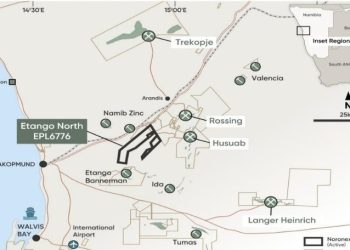
Golden Deeps Ltd has applied for uranium exploration licences near the Langer Heinrich Uranium Mine in western Namibia, citing geological indicators consistent with palaeochannel-hosted uranium mineralisation.
The company said satellite imagery has identified drainage systems linked to uranium-bearing granites, suggesting potential for Langer Heinrich–style calcrete uranium deposits. The tenements have been offered for grant, subject to the completion of Environmental Compliance Certificates.
Golden Deeps said its subsidiary, Huab Energy Pty Ltd, applied for three exclusive prospecting licences south of the Langer Heinrich mine. Langer Heinrich is a palaeochannel calcrete uranium deposit with a reported 2016 mineral resource of 72.3 million tonnes at grades of 0.06% to 0.07% U₃O₈, containing 44,000 tonnes of U₃O₈, and is operated by Paladin Energy Ltd.
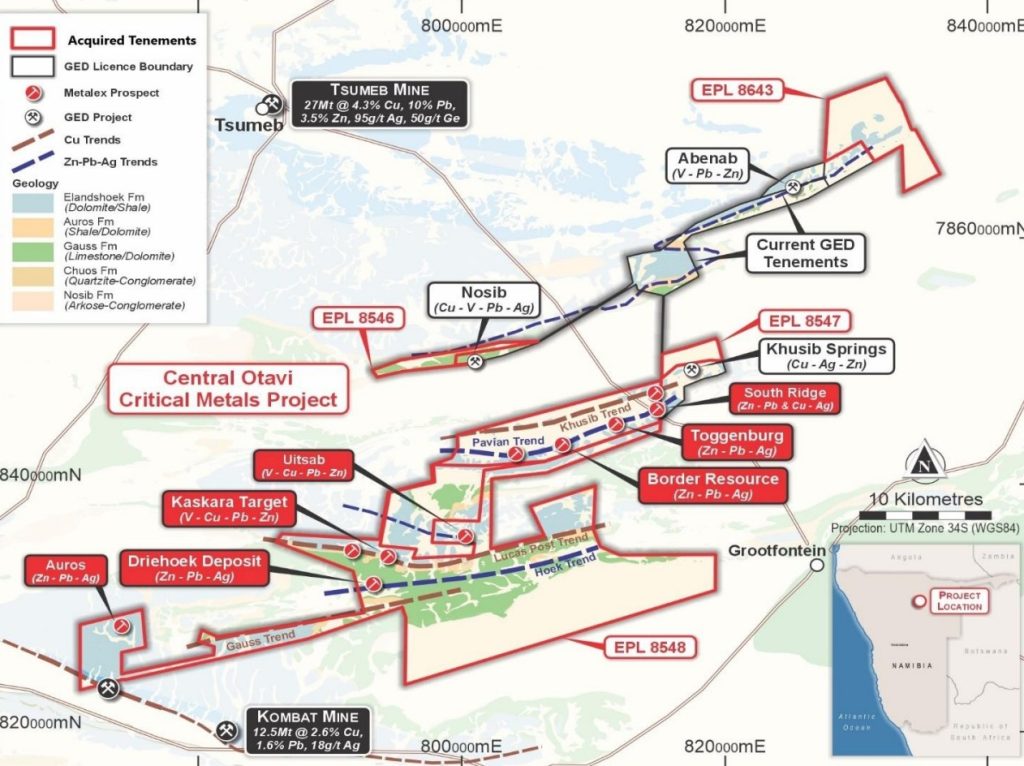
Separately, the company reported high-grade copper and silver results from its recently acquired Central Otavi Critical Metals Project in northern Namibia, strengthening the project’s potential to host a Tsumeb-style polymetallic deposit.
Exploration during the December quarter focused on the Graceland prospect within the Otavi Mountain Land Critical Metals Belt, a region known for hosting some of the world’s highest-grade polymetallic mines, including the historic Tsumeb mine and Kombat mine.
At Graceland, Golden Deeps identified multiple gossans and sulphide mineralisation over a corridor measuring approximately three kilometres by one kilometre. Rockchip and channel sampling returned high-grade results, including assays of up to 50.6% copper, 7,792 g/t silver, 35.4% zinc and 224 g/t germanium.
Channel sampling across the main Gossan 1 outcrop delivered particularly strong intersections, including up to 42.7% copper, 1,353 g/t silver and 351 g/t germanium. Additional high-grade copper, silver, zinc, lead and antimony results were returned from Gossan 1 East, about 250 metres along strike, confirming continuity of mineralisation.
Wide zones of zinc-lead mineralisation with elevated germanium were also identified at the nearby Gossan 2 outcrop, highlighting the polymetallic nature of the system.
To test depth potential beneath the high-grade surface zones, Golden Deeps commenced shallow diamond drilling in December 2025 using a newly acquired man-portable drill rig. The first drill hole intersected strongly mineralised, silicified dolomite containing semi-massive chalcocite and copper carbonates, confirming sulphide mineralisation immediately below surface.
Drilling continued into January 2026, with the company saying results will be released once assays are available.
Golden Deeps has also completed an induced polarisation and resistivity geophysical survey over a two-kilometre section of the Graceland corridor. The survey identified anomalies aligned with the high-grade gossans, consistent with structures known to host sulphide mineralisation at the Tsumeb deposit, located about 20 kilometres to the north.
The company said further soil and rockchip sampling has extended the mineralised corridor to more than three kilometres in strike length, with results pending. Integration of drilling, geophysical data, sampling and 3D modelling is under way to refine targets ahead of a deeper drilling programme.