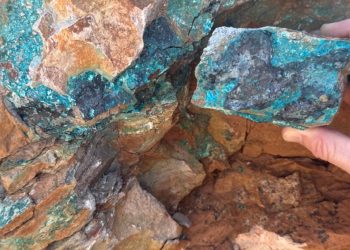
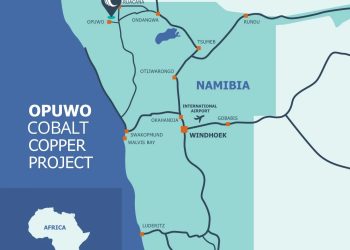
Golden Deeps Limited is stepping up exploration for high-grade copper, silver and germanium mineralisation at its Graceland prospect in northern Namibia after drilling returned copper grades of up to 9.2% and zinc grades of up to 23.2%.
The company has launched a deeper diamond drilling programme targeting potential sulphide deposits beneath previously identified mineralised zones at Gossan 1 and Gossan 1 East, with up to 10 initial drill holes planned.
Golden Deeps Chief Executive Officer Jon Dugdale said the latest exploration results had strengthened the company’s confidence in the potential for deeper mineralisation across the Graceland prospect.
“The spectacular and consistent results we have received from our earlier work programs at Graceland give us confidence that the multiple targets identified by the IP survey show potential for copper-silver-zinc-lead and germanium bearing sulphide zones,” Dugdale said.
The deeper drilling campaign follows assay results from four shallow diamond drill holes, which confirmed the continuation of mineralised zones beneath Gossan 1 and Gossan 1 East.
At Gossan 1 East, drilling returned grades of up to 9.2% copper and 417 grams per tonne (g/t) silver, while results from Gossan 1 included up to 23.2% zinc, 8.2% lead and 118 g/t germanium.
Germanium is a critical mineral used in semiconductor manufacturing and other advanced technologies.
One of the significant intersections at Gossan 1 East was recorded in drill hole GLBPD007, which returned 4.48 metres grading 4.0% copper equivalent, including 2.28 metres grading 7.3% copper equivalent.
The intersection included grades of 4.55% copper and 150 g/t silver.
At Gossan 1, drill hole GLBPD009 intersected 8.20 metres grading 3.5% copper equivalent, including 2.12 metres grading 6.2% copper equivalent.
Dugdale said the company was now moving beyond shallow drilling to investigate whether the high-grade mineralisation extended into deeper sulphide zones.
“Golden Deeps also commenced its deeper diamond drilling program at Graceland high-grade critical metals prospect – testing the high-priority targets identified within the Gossan 1 corridor by our previous systematic exploration programs, which have included rock chip and channel sampling, shallow drilling and IP surveys,” he said.
The programme is initially targeting anomalies identified through induced polarisation (IP) surveys, which are used to detect subsurface geological features potentially associated with sulphide mineralisation.
Dugdale said drilling was underway beneath Gossan 1, with additional targets planned at Gossan 1 East and Gossan 1 Far East.
“The diamond drilling program is currently testing the IP target below the high-grade Gossan 1 zone, with drilling planned to test the Gossan 1 East target and the strongest IP anomaly detected to date at Gossan 1 Far East,” he said.
Golden Deeps identified Gossan 1 Far East as a priority target after surveys detected the largest and strongest IP anomaly recorded along the corridor.
The target has no visible surface expression and remains open to the east and at depth, with drilling required to determine whether it hosts economic mineralisation.
The company said further drilling would depend on the results of the initial programme.
Meanwhile, Golden Deeps is continuing soil, rock-chip and channel sampling at its South Ridge and Butterfly North prospects to identify additional copper, lead, zinc and silver targets.
At Butterfly North, the company is evaluating a high-chargeability anomaly identified by previous IP surveys along strike from the Khusib Springs copper-silver mine.
The geophysical data will be modelled to guide future drilling.
Golden Deeps’ exploration activities are concentrated in Namibia’s Otavi Mountain Land, where the company is investigating several prospects considered prospective for Tsumeb-type polymetallic deposits.