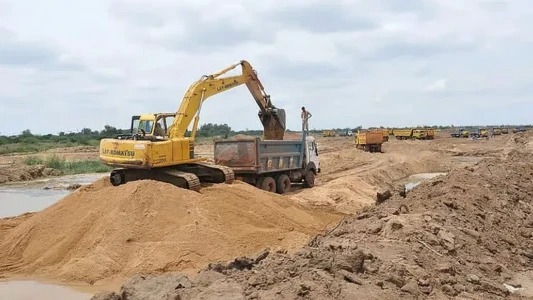
The government is drafting new regulations to introduce stricter controls and penalties for illegal sand and gravel extraction as authorities struggle to enforce environmental laws against unregulated mining activities across Namibia.
Environment, Forestry and Tourism Minister Indileni Daniel said the absence of specific regulations governing sand and gravel extraction had made it difficult to prosecute offenders and hold operators accountable for environmental damage.
Speaking in Parliament, Daniel said the proposed regulations would establish clearer requirements for environmental clearance certificates, permits, site management, rehabilitation and compliance monitoring.
“We are currently in the process of developing standalone regulations for sand and gravel extraction. At the moment, we do not have specific regulations that adequately address these activities, which makes it difficult to hold illegal miners and those responsible for environmental damage accountable under the Environmental Management Act,” she said.
Daniel revealed that 15 cases of illegal sand mining had been reported in the Oshana Region alone, highlighting continued enforcement challenges, particularly in northern Namibia.
She said the ministry had received 56 applications for environmental clearance certificates for sand and gravel extraction across several regions, including Kunene, Zambezi, Kavango East and Kavango West.
However, she said the existing legal framework did not provide sufficiently specific penalties for illegal sand and gravel extraction, limiting the government’s ability to take action against offenders.
“Once these regulations are adopted, they will provide strict measures and procedures for sand and gravel mining, including punitive measures. At present, we do not have a legal instrument that allows us to introduce specific penalties for these activities,” Daniel said.
The minister said the proposed regulations would also clarify the responsibilities of mining operators, including requirements to rehabilitate extraction sites and comply with environmental conditions.
She revealed that the ministry, working with the Roads Authority, had rehabilitated more than 30 borrow pits, mainly in northern Namibia, as part of efforts to address environmental damage caused by extraction activities.
Daniel said environmental inspections had uncovered sand and gravel extraction activities being carried out without the required environmental clearance certificates by government institutions, private companies and individuals.
“Environmental inspections and awareness campaigns have identified activities conducted without the required clearance certificates by government institutions, private companies and individuals,” she said.
She called on local and regional authorities, as well as communities, to report illegal extraction activities to strengthen enforcement and prevent further environmental degradation.
Daniel said the ministry would continue conducting inspections and awareness campaigns while finalising the regulations.
The proposed legal framework is expected to strengthen government oversight of sand and gravel extraction, particularly as demand for construction materials continues to place pressure on natural resources.
The minister did not provide a timeline for the completion or implementation of the regulations.