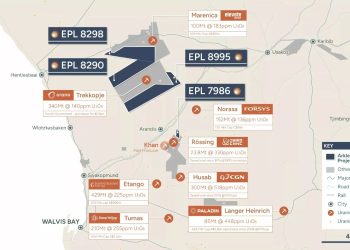
Elevate Uranium has reported a combined mineral resource of 129 million pounds of uranium oxide across its Marenica and Koppies projects in Namibia, with further drilling and metallurgical studies planned to expand resources and advance the projects towards feasibility assessments.
According to the company’s 2026 annual report, the Marenica project holds an estimated 52.8 million pounds of uranium oxide (U₃O₈), while the wider Koppies project area accounts for 76.2 million pounds, including satellite deposits at Hirabeb and Namib IV.
The company said exploration and resource drilling at Marenica had nearly doubled the estimated uranium grade to 180 parts per million (ppm), compared with the previous estimate of 94 ppm.
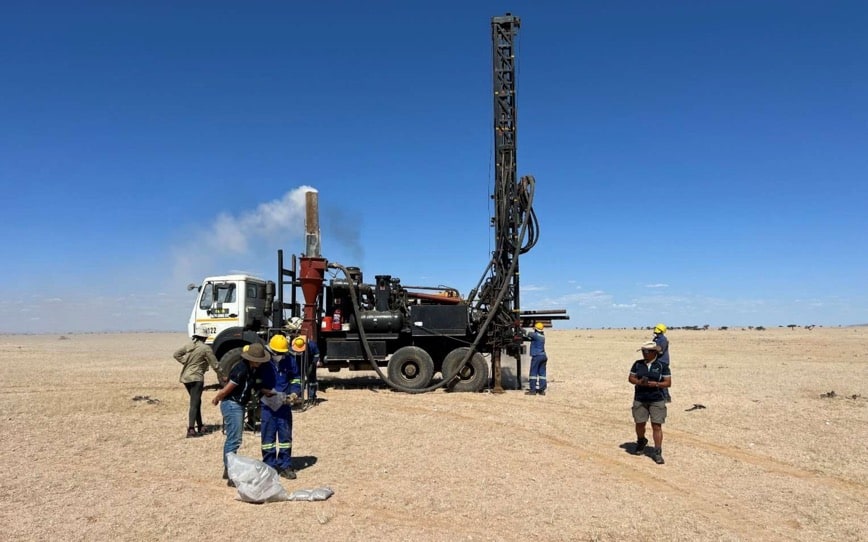
The improvement followed an extensive drilling and resource reassessment programme involving 1,598 holes covering 61,909 metres during the reporting period.
Elevate said drilling would continue into late 2026 to upgrade inferred mineral resources to the higher-confidence indicated category and investigate mineralised areas outside the existing resource boundaries.
A further mineral resource update is expected following completion of the programme.
The company is also undertaking metallurgical testwork at Marenica using its proprietary U-pgrade beneficiation process, which was originally developed using uranium mineralisation from the project.
Bulk samples collected from test pits across the resource area are being processed through a pilot plant to establish the technical parameters required for future feasibility studies.
“Marenica’s mineralogy has proven well-suited to the U-pgrade process and the current program is designed to generate the processing parameters required to advance the project through feasibility studies,” the report stated.
At Koppies, the company reported a total resource of 76.2 million pounds, comprising 43.6 million pounds of indicated resources and 12.3 million pounds of inferred resources at the main deposit.
The satellite deposits at Hirabeb and Namib IV contribute a further 10.2 million pounds and 10.1 million pounds, respectively, both classified as inferred resources.
Elevate said the indicated resource at Koppies provided a basis for advancing the project towards development, supported by the size and continuity of the central uranium deposit.
The main mineralised area extends approximately seven kilometres from north to south and 3.5 kilometres from east to west, with additional smaller mineralised zones to the west and north.
The company said the continuity of the deposit was an important consideration for potential future mining operations.
Further exploration at Hirabeb has identified uranium mineralisation approximately 1.2 kilometres north of the existing resource area, while the northwestern section remains open for additional drilling.
At Namib IV, Elevate reported a maiden mineral resource estimate of 10.1 million pounds during the year.
The mineralised system extends approximately five kilometres, with uranium occurring at depths of up to 25 metres.
The company said mineralisation remained open to the northeast and south of the current resource boundary, indicating potential for further resource growth.
Approximately 8.2 million pounds, representing 81% of the Namib IV resource, is hosted in weathered basement rock, with the remaining uranium occurring in calcrete formations.
Elevate said the identification of basement-hosted uranium mineralisation had increasingly influenced its exploration strategy across the Erongo Region.
The company also reported exploration progress at the Capri prospect, located approximately 25 kilometres from Marenica, where drilling has identified two mineralised zones extending up to 16 kilometres along strike.
During the year, Elevate completed 67 drill holes covering 1,878 metres at Capri to improve the definition of the mineralised areas.
The company currently holds six active exploration tenements across its Marenica and Koppies project areas in the Erongo Region.
Elevate said continued drilling, resource upgrades and metallurgical testwork would support the next stages of project assessment as it seeks to advance its Namibian uranium assets towards potential development.