Arkle Resources has confirmed a uranium discovery at its Erongo project in Namibia after eight of nine drill holes intersected uranium mineralisation at the ULG target.
The company said the mineralised system extends across an area measuring approximately 1.4 kilometres by 600 metres, with follow-up drilling planned for November 2026 to test the discovery at greater depths and beyond its current footprint.
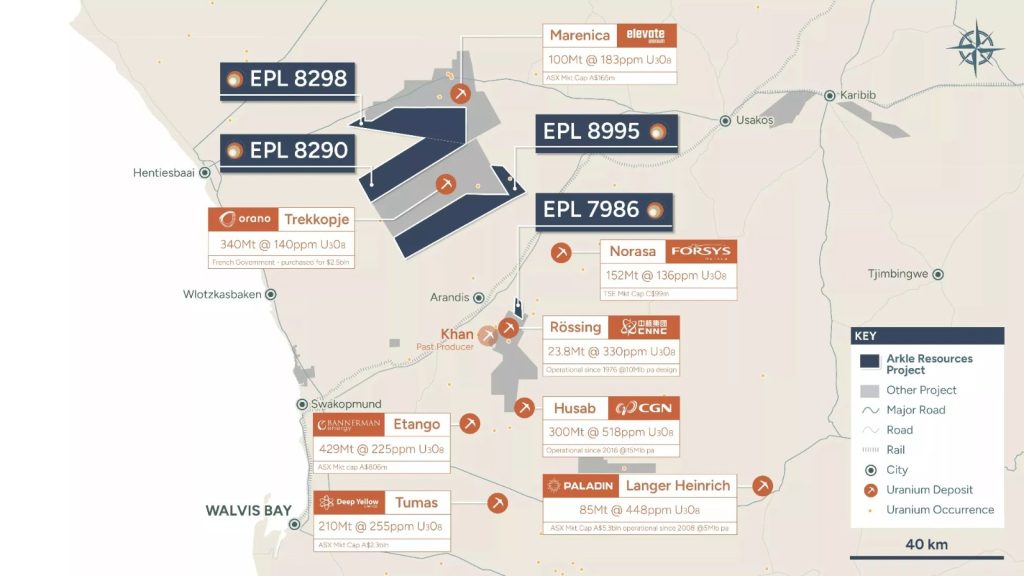
The drilling was conducted on exploration licence EPL 8995, about 12 kilometres west-southwest of the company’s Paleo East channel.
The strongest result was recorded in hole R069, which intersected 41 metres grading 141 parts per million (ppm) uranium oxide (U₃O₈) from a depth of 59 metres.
The hole remained mineralised at the end of drilling and included a higher-grade section of four metres at 240 ppm U₃O₈ from 64 metres. Individual samples from the drilling programme returned grades of up to 421 ppm.
Three drill holes ended in mineralisation, indicating that the uranium system could continue at depth.
Arkle Chief Geologist Chris M. Healey said the discovery was made on only the third hole drilled at the ULG target.
“I am really excited to see this success so early in our exploration of EPL 8995. We intersected highly significant uranium mineralisation on only the third hole we drilled on our ULG target,” Healey said.
“Exploration companies can drill many dozens of holes before making a discovery, if they ever succeed at all. In 1988 I was part of the team that discovered Cameco’s massive McArthur River deposit in Saskatchewan, and we made our discovery there on hole number 198. Here at the Arkle Erongo project, we have done it at hole number 3.”
The company said the approximately 1.4-kilometre by 600-metre mineralised area corresponds with the footprint previously identified through surface exploration.
Arkle is planning a fully funded follow-up drilling campaign provisionally scheduled to start in November, subject to contractor availability.
The programme will target deeper mineralisation, reduce spacing between drill holes and test extensions beyond the currently defined mineralised area.
The ULG results follow earlier drilling at the Paleo East target, where Arkle confirmed uranium mineralisation in surficial calcrete deposits.
Arkle said the results indicate the presence of both calcrete-hosted and primary leucogranite uranium mineralisation across its licence area.
The company is assessing at least four additional leucogranite targets and plans further exploration at ULG as it works towards a maiden mineral resource estimate in 2027.