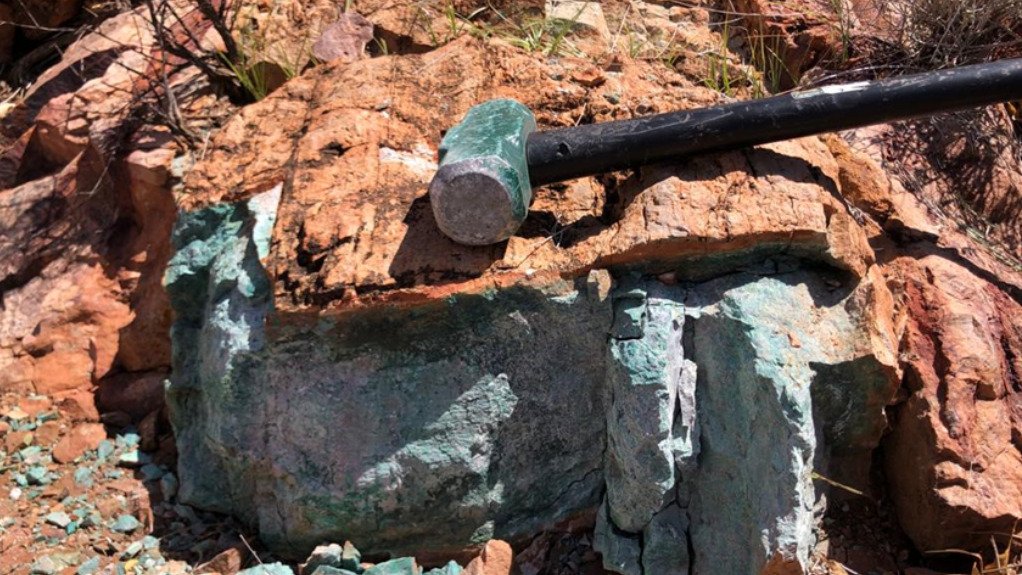
Koryx Copper has reported its longest continuously mineralised intersection to date at the Haib Copper Project in southern Namibia, as infill drilling nears completion ahead of an updated mineral resource estimate expected later this year.
The company reported assay results from 19 drill holes covering 8,586 metres under its ongoing infill and expansion drilling programme at the wholly owned project.
The standout result came from drill hole HM167, which intersected 969 metres grading 0.27% copper equivalent (CuEq) from surface, including 58 metres at 0.45% CuEq and 28 metres at 0.42% CuEq.
Koryx President and Chief Executive Officer Heye Daun said the intersection is the longest mineralised interval recorded at Haib to date and adds to recent drilling results showing broad zones of mineralisation alongside higher-grade sections.
“These results continue the trend of recent months, with exceptional widths at consistent and regular higher grades above the average MRE grade. HM167 returned 969m at 0.27% CuEq from surface, which is our longest mineralised intersection at Haib to date,” Daun said.
Other significant results included HM185, which returned 413 metres at 0.41% CuEq, including 236 metres at 0.57% CuEq.
HM177 intersected 413 metres at 0.38% CuEq, including a near-surface interval of 30 metres at 1.10% CuEq from a depth of eight metres and a further 10 metres at 1.33% CuEq at depth.
“HM185 delivered 236m at 0.57% CuEq and HM177 returned 30m at 1.10% CuEq from only 8m depth, again demonstrating the high-grade potential of the system,” Daun said.
Koryx said all 19 holes intersected thick zones of mineralisation, with several returning grades above the average mineral resource estimate grade.
Drilling at Target Area 1 also returned higher-grade copper mineralisation beyond current models. HM177 included two separate two-metre intervals grading above 4% copper within a broader 30-metre section averaging 1.06% copper.
The hole also intersected 64 metres averaging 0.43% copper, including six metres grading 1.86% copper and 1,128 parts per million molybdenum. Gold grades increased at depth, reaching up to 0.36 grams per tonne.
At Target Area 2, HM164 returned 855 metres at 0.28% CuEq, including 110 metres at 0.50% CuEq and 48 metres at 0.52% CuEq. Koryx said molybdenum grades contributed materially to the copper-equivalent grade across much of the intersection.
HM168 returned 728 metres at 0.32% CuEq, while HM165 intersected 600 metres at 0.30% CuEq, providing further evidence of mineralisation continuity across the deposit.
“With this batch, our infill drilling is nearing completion, and results continue to trend to the upside ahead of the expected late 2026 mineral resource update,” Daun said.
Haib is a large porphyry copper deposit containing copper, molybdenum and gold mineralisation and is being evaluated for development as a large-scale open-pit mining operation.
Koryx said the latest drilling will feed into the planned mineral resource update as it continues work to define the scale, grade and development potential of the Haib deposit.