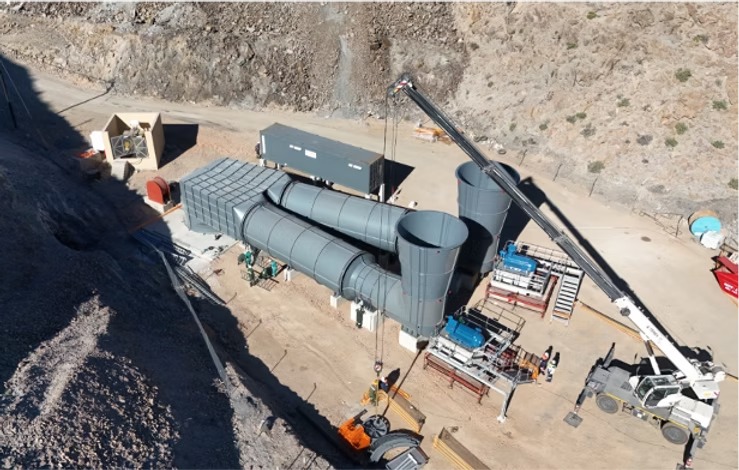
Rosh Pinah Zinc has commissioned two new surface ventilation fans as part of its RP2.0 expansion project, marking another key milestone in the mine’s expansion.
The fans draw air through a newly developed 207-metre ventilation raise shaft extending from the surface to the 200 level, strengthening airflow to support the mine’s expanded operations.
Howden Industries, part of the Chart Industries group, supplied and installed the fans. Installation began in April following the handover of the completed civil works by Namibia Construction at the end of March. Master Drill was simultaneously completing shotcreting work on the upper 15 metres of the ventilation raise.
“Howden Industries, part of the Chart Industries group, was appointed to supply and install the new fans. The team arrived on site at the beginning of April to complete onboarding and site establishment, shortly after Namibia Construction handed over the completed civil works at the end of March. Fan components soon began arriving by truck as the installation got under way,” the company said in a statement.
The mechanical installation of both fans was completed around 20 June, after which the site was handed over to DRA for electrical, control and instrumentation works. DRA, together with Raylec, installed the motor control centre and cable racks and upgraded the 11kV reticulation from temporary construction power to a permanent 11kV supply.
Final mechanical work was completed in late July ahead of commissioning. This included motor direction testing, shaft connection, alignment and balancing.
“With commissioning targeted for the first week of August, Howden’s team returned during the last week of July to complete the final mechanical tasks, among them the motor direction test, which could only be carried out once the EC&I installation was finished. This was followed by the shaft connection between motor and fan, with alignment and balancing completed by Howden’s specialist alignment technician,” the statement said.
Fan No. 2 was started on 4 August after minor interlock issues were resolved by DRA technicians. It was operated for at least four hours for testing, with vibration, airflow, temperature and sound levels all recording what the company described as “excellent results”.
Fan No. 1 was commissioned the following day under the same testing procedures and also recorded positive results.
The commissioning involved collaboration between Howden, Namibia Construction, Master Drill, DRA and Raylec, marking further progress on the RP2.0 expansion project.