Namibia drilled 27 exploration and appraisal wells between 2021 and 2026, while the Orange Basin recorded 14 petroleum discoveries as the country’s offshore oil and gas industry shifts from frontier exploration towards appraisal and potential development.
Acting Petroleum Commissioner Aune Amutenya said the acceleration in drilling has transformed Namibia from a largely unexplored petroleum province into one of the world’s closely watched offshore exploration markets.
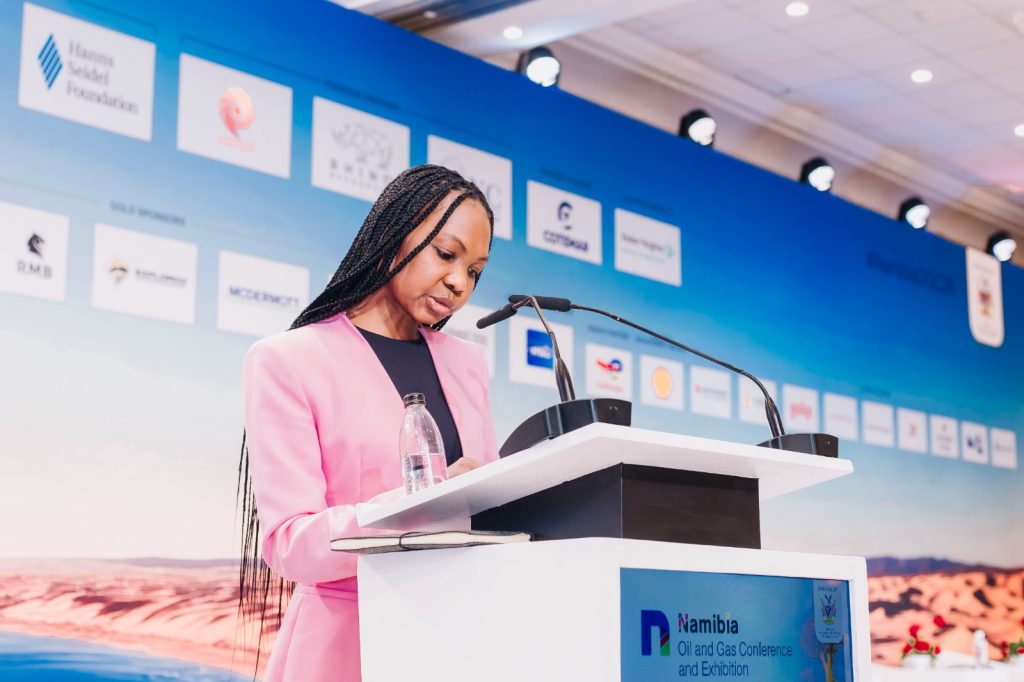
Speaking at the Namibia Oil and Gas Conference 2026, Amutenya said the industry is increasingly moving beyond establishing the presence of hydrocarbons towards determining which discoveries can be commercially developed.
“Twenty-seven exploration and appraisal wells were drilled between 2021 and 2026 as part of the recent exploration phase. This number is particularly important when one considers that Namibia was, until very recently, regarded as a frontier petroleum province,” she said.
Amutenya said the Orange Basin has yielded 14 discoveries by various operators, including Venus, Mopane, Graff, La Rona, Lesedi, Jonker and Capricornus.
The country currently has 20 active petroleum exploration licences covering offshore and onshore acreage, with the government seeking to sustain exploration beyond the Orange Basin.
“Namibia’s future should not be defined by one basin or one discovery. The Orange Basin has become the centre of international attention, but exploration continues in other basins and objectives,” Amutenya said.
“Our objective right now is to maintain a balanced exploration programme that allows us to advance existing discoveries while continuing to test new geological opportunities.”
Exploration activity has been supported by extensive seismic data acquisition, with more than 109,000 kilometres of seismic data and approximately 84,000 square kilometres of seismic coverage acquired to date.
“To date, we have acquired more than 109,000 kilometres of seismic data and approximately 84,000 square kilometres of seismic coverage. These extensive datasets have been fundamental in the identification and maturation of prospects. This illustrates the value of petroleum data,” Amutenya said.
About 3,000 kilometres of new seismic surveys have also recently been completed, with further programmes planned in Blocks 2912 and 2930 to improve subsurface imaging, reduce geological uncertainty and advance prospects towards drilling decisions.
The next phase is expected to include further drilling, with more than 10 wells planned in the Orange Basin over the next two to three years.
“Looking forward, we have identified more than 10 wells that are planned to be drilled in the Orange Basin during the next two to three-year period,” Amutenya said.
“Drilling activity is no longer purely exploration drilling. It is becoming a combination of exploration, appraisal, development and eventually production wells.”
Amutenya said Venus remains the country’s most advanced petroleum development, with a final investment decision expected in 2026 and first oil currently forecast for 2030. Mopane remains under appraisal, with further drilling aimed at determining the size and commercial viability of the discovery.
She said the focus is increasingly shifting towards converting Namibia’s exploration success into commercially viable developments.
“Our challenge is no longer simply to discover oil. Our challenge is to convert discoveries into commercially viable projects, projects into production and production into national development,” Amutenya said.