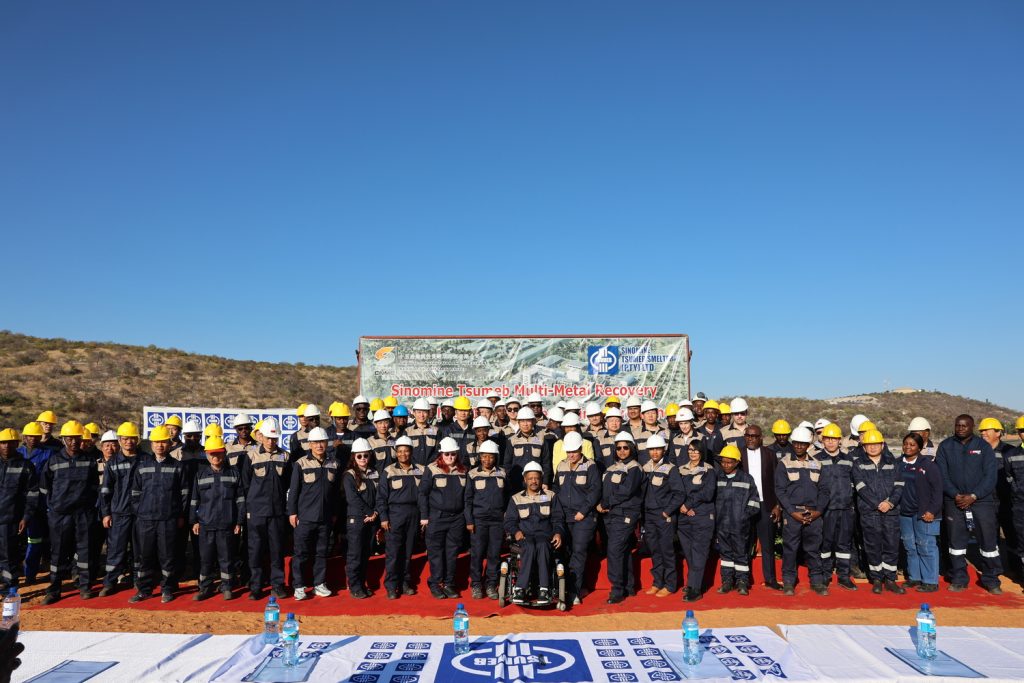
In the second quarter of 2026, Sinomine Tsumeb Smelter (Sinomine) successfully commenced with the construction of N$4 billion Multi-Metal Recovery Plant (MMR), which will be situated in Tsumeb.
The N$4 billion investment, which is the first of its kind, is earmarked to process critical metals, primarily Germanium, from old tailings stocks that were generated from historic mining activities within Tsumeb area.
The MMR Plant is a prime example of circular economy in action and environmental stewardship as it transforms legacy mining waste into a valuable strategic resource, while reducing the environmental footprint of historic operations.
This aligns with the government’s vision of Environmental Sustainability as stated in the Sixth National Development Plan (NDP6).
The CEO of Sinomine, Mr. Lou described the MMR plant as a transformative opportunity not only for Sinomine but also for Namibia, saying the project validates how previously overlooked resources can be converted into high- value products through innovation and advanced technology.
The investment will incorporate state-of-the-art processing technologies, further positioning Namibia as a global leader in the sustainable production of critical metals.
During a visit to the site in June 2026, Sinomine Resources Group Chairman Wang Pingwei expressed confidence in Namibia as an investment destination and highlighted the project’s potential to transform the local economy.
He said the investment would not only create jobs and stimulate industrial growth but also strengthen Namibia’s position in the global critical metals value chain through advanced technology, innovation and sustainable development.
During the recent Namibia–China State visit Sinomine CEO, Mr. Lou stated that the investment aims to revitalize the Tsumeb community by spurring economic activities, creating close to 1600 jobs during construction, and more than 500 jobs post construction.
The project will introduce advanced technologies, which will require a strong emphasis on skills transfer and capacity building, thus equipping Namibians by developing a skilled workforce capable of supporting Namibia’s growing industrial and minerals sectors.
He said Sinomine’s focus will be on strengthening Namibia’s manufacturing sector and helping to develop a more complete industrial value chain.
Mr. Lou stated that despite the challenges faced by the company since the acquisition by the Sinomine Resource Group in September 2024, the commitment of its employees and stakeholders is enabling the company to execute its vision.
The decline in the copper concentrate tolling markets resulted in the temporary suspension of the copper processing operations in August 2025.
The copper smelting facility has been placed under care and maintenance, while the investors continue to monitor the copper concentrate tolling market conditions.
Despite these challenges, Sinomine recognizes that corporate social responsibility is an integral part of sustainable business and is committed to operate in a manner that promotes the wellbeing of employees, communities and environment.
Sinomine has retained a workforce of 336 employees of which 95.5% are local employees, while 4.5% are foreign nationals. The Sinomine management is made up of 75% of Namibian employees.
Since the acquisition in September 2024, the company has invested a total of N$4.6 million in community development initiatives in and around the Oshikoto Region, despite the challenging global economic climate.
Of the N$4.6 million, close to 50% of the total investment was to promote educational performance, which is a strong focus for Sinomine. One of its success projects is the Math and Science Clinic (MSC) Programme which focuses on improving competencies of AS Learners, in Science, Technology , Engineering and Mathematics (STEM) related subjects. The focus on STEM subjects is driven by the growing demand for skills in effort to support Namibia’s growing industrial and minerals sectors.
The programme was successfully implemented in 2024 and 2025 by the Smelter’s Community Trust in partnership with the Oshikoto Directorate of Education and the José Eduardo dos Santos UNAM Campus.
This came after extensive education workshops held with learners and teachers respectively, to address critical issues affecting education in the region.
As a result of the MSC, there has been an improvement in student performance in Physics and Chemistry, with average increases of 18.7% and 19.1% respectively, in 2024 compared to 2023. These results confirm that the interventions provided through the MSC program have had a positive impact on these subjects.
As part of its investment in education, Sinomine procured IT equipment to a total value of N$800,000 for various schools and institutions. The equipment included 14 laptops and 14 data projectors valued at close to N$300,000 for 14 secondary schools in the Oshikoto Region and an additional six desktop computers worth N$100,000 to the Tsumeb Teachers’ Resource Centre.
In addition, laptops, printers, laboratory equipment, smart TVs, data projectors and photocopiers valued at nearly N$400,000 were donated to the Math and Science Clinic to support digitalization and enhance the learning experience of school learners.
Another flagship project is the N$3 million AgriHub, which is a Community Investment Agreement signed in August 2023 between Tsumeb Constituency Regional Council, Tsumeb Municipality and Sinomine.
The project is aimed at the establishment of a community driven Agro Scheme in Tsumeb, by creating sustainable livelihoods for the Tsumeb Community through income generation and enhanced food security.
Sinomine’s accountability is the setting up of the infrastructure and commissioning of the first harvest. Post commissioning, the Tsumeb Constituency Regional Council will operate the project as a revenue generating business with the aim of reinvesting the profits and expanding the agricultural footprint in the region.
For the first phase of the AgriHub project, N$800,717 was spent on debushing of the land which created employment for 50 local residents, procurement of irrigation system and land surveying and mapping amongst others.
Sinomine through the Sinomine Resource Group continues to honour this commitment and has earmarked a further N$2,199,283 for the development of the five- hectare agricultural project.
This will include the installation of irrigation systems, fencing, solar system, production inputs and training of local residents.
The Executive Vice President of Sinomine, Ms. Barcelona Tsauses explained that this project aims to create opportunities for community members with limited skills who are unable to participate directly in Sinomine’s operations, enabling them to earn an income and improve their quality of life.
“Creating sustainable livelihoods outside Sinomine activities are crucial for long-term value addition which will stand even beyond the smelter’s existence.” Ms. Tsauses said.
She added that Sinomine’s vision extends beyond operational activities, encompassing educational opportunities and sustainable livelihoods for the next generation. This investment will enable Sinomine to amplify their Community Development efforts.
Therefore, the over N$4 billion investment embodies a renewed promise for environmental stewardship, global positioning in the critical metals sector, skills transfer and community upliftment. As construction begins, Sinomine remains committed in their effort toward a sustainable future for Tsumeb and Namibia.