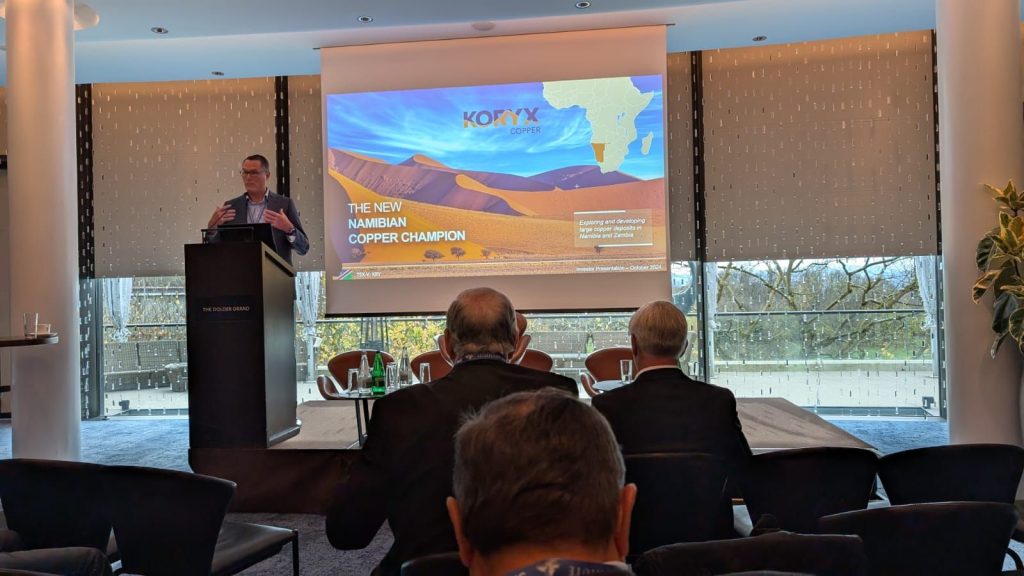
Koryx Copper Inc. says optimisation work at its Haib Copper Project in southern Namibia has delivered encouraging results, with metallurgical testing indicating potential improvements in processing throughput, copper grades and overall operating efficiency ahead of the project’s Pre-Feasibility Study (PFS).
The company said process flow sheet optimisation is largely complete and has been driven by an updated mineral resource model, a revised mine plan and several processing enhancements, including the application of coarse particle flotation (CPF) technology.
According to Koryx, the CPF process allows low-value waste material to be removed earlier in the processing circuit, improving the grade of material sent for further treatment.
Koryx Copper President and Chief Executive Officer Heye Daun said the test work has demonstrated significant potential benefits for the project.
“Utilising CPF in a coarse gangue rejection application, flotation processing grade is expected to increase to between 0.45 and 0.50% on a CuEq basis,” Daun said.
He added that CPF could materially improve the economics of the project by increasing throughput while simplifying the processing flow sheet.
According to the company, test work indicates that up to 25% of run-of-mine material could be rejected as coarse tailings with minimal copper losses. This would allow more ore to be processed through existing infrastructure while reducing both energy and water consumption.
Koryx said the optimisation programme also includes a significant revision to the processing strategy, with all sulphide material now expected to be treated through conventional milling and flotation.
The company has removed the previously proposed sulphide heap leach circuit from the development plan, a move it believes will simplify capital requirements and improve metallurgical performance.
“The project will be powered by a 200 MVA connection to Namibia’s national grid, supplemented by hybrid solar photovoltaic generation and battery storage, while water supply will be sourced from the Orange River with additional storage capacity planned to manage seasonal variability,” Daun said.
Environmental and permitting activities are also progressing, with the company having completed 13 specialist studies to date.
Koryx is targeting environmental approval during the first half of 2027, while the Pre-Feasibility Study remains on track for completion before the end of 2026.
The company said further trade-off studies are underway, including assessments of transport routes through Lüderitz and Walvis Bay, tailings storage options and the potential construction of an on-site sulphuric acid plant using pyrite concentrate for future heap-leaching operations.
Haib is one of Namibia’s largest undeveloped copper projects and forms a key part of Koryx Copper’s strategy to develop a large-scale, long-life copper operation as global demand for the metal continues to rise.