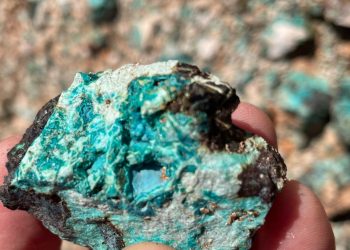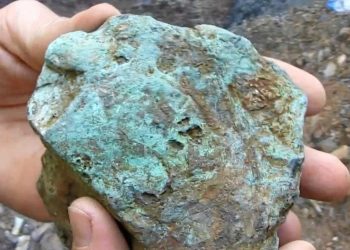
Serval Resources Plc says its maiden geological mapping programme in Namibia’s Kaoko Basin has confirmed multiple occurrences of copper mineralisation across two key exploration licences, strengthening the company’s confidence in the area’s potential to host significant copper deposits.
The AIM-listed explorer said fieldwork completed on Exclusive Prospecting Licences (EPL) 7081 and 7079 identified both historically known copper occurrences and new zones of surface mineralisation, providing fresh targets for further exploration.
The results are expected to guide the next phase of exploration, including geophysical surveys, soil sampling and potential drilling programmes.
“It is exciting that we had our first opportunity to get feet on the ground and start to do work in Namibia. Our land package in the Kaoko Basin is large and one of our positive challenges is target prioritisation, which we aim to address through a systematic approach to exploration. Geological mapping is an important component of this, as it can be used to refine geological interpretations and identify priority zones for follow-up geophysical and soil sampling programmes before future drilling to expand the known mineralisation. In terms of the findings of this initial programme, it has confirmed the prospectivity of these EPLs and it is, of course, encouraging to see extensive copper mineralisation at surface,” said Chief Executive Officer Robin Birchall.
The company also announced the renewal of Environmental Clearance Certificates (ECCs) for EPL 7079 and EPL 7082, allowing exploration activities to continue for a further three years.
“I would also like to congratulate our team for the receipt of the important ECC renewals, which demonstrate our commitment to sustainable and responsible exploration practices, as well as our experience and capabilities in environmental management,” Birchall said.
EPL 7081, regarded as Serval’s highest-priority licence, hosts several established prospects, including Omatapati, Otjozongombe and Horseshoe, where historical drilling has previously intersected copper-silver mineralisation.
Mapping over an area of approximately 20 square kilometres confirmed visible copper mineralisation associated with the Nosib and Otavi contact zones, particularly within the Omivero Shale and Lower Omao formations.
At the Omatapati prospect, copper mineralisation was identified along the Lower and Upper Omao contacts and appears to extend further to the south-east.
Meanwhile, at the Horseshoe prospect, mineralisation was observed at the hinge of a large syncline and along both its northern and southern limbs, indicating potential for further extensions along strike.
On neighbouring EPL 7079, Serval completed geological mapping across 25 square kilometres in three priority areas.
The company identified favourable geological settings for copper mineralisation, including contacts between the Nosib Group and Omivero units, as well as the Lower and Upper Omao formations.
Visible copper mineralisation was recorded in the southern focus area, while additional mineralisation was observed at the Ohundayamboto prospect.
Serval said extensive surface cover in the northern and central areas means further geophysical and geochemical work will be required before drill targets can be defined.
The company believes the latest results reinforce the prospectivity of its broader Kaoko Basin land package, particularly given its proximity to the Taranis/Okohongo copper-silver project, one of Namibia’s most significant undeveloped copper assets.