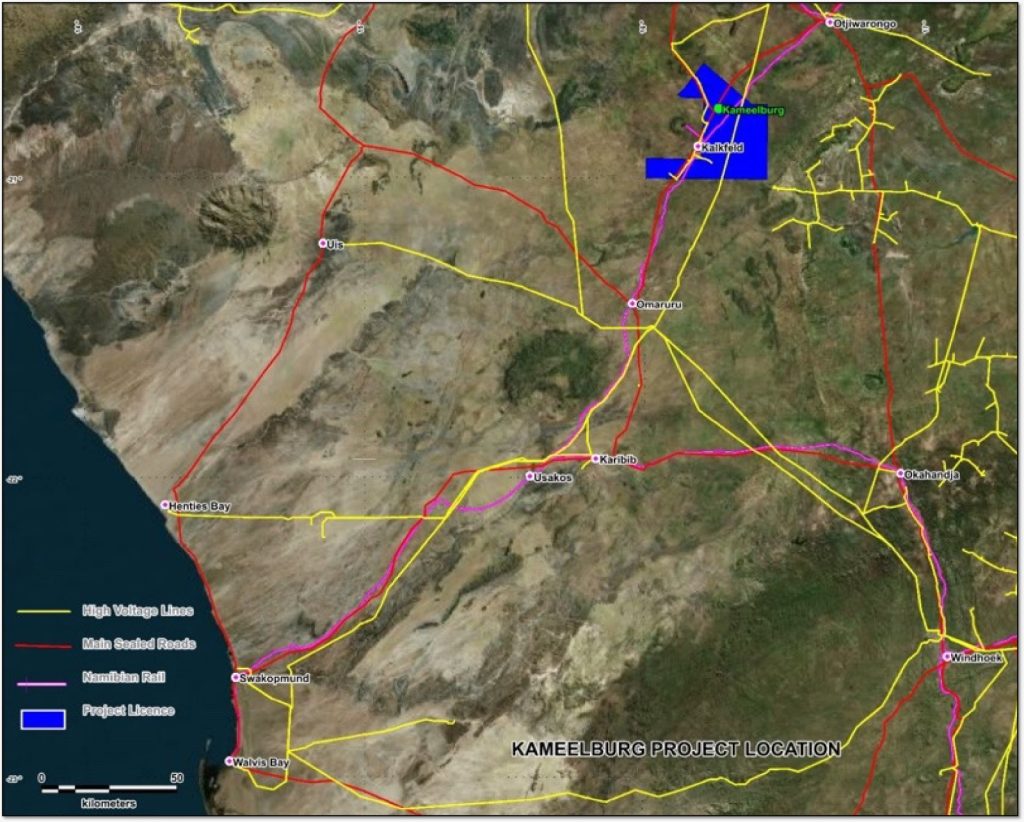
Aldoro Resources says it remains on track to deliver an updated Mineral Resource Estimate (MRE) for its Kameelburg Rare Earth Element Project in Namibia in June, as the company moves ahead with metallurgical test work and bulk sampling activities.
The company is mobilising its specialised Smart 8 drilling rig to the project site to begin bulk sampling across the Kameelburg carbonatite deposit.
According to Aldoro, the work is aimed at accelerating metallurgical testing and supporting future project definition studies.
“Aldoro’s Smart 8 drilling rig is being mobilised to commence bulk sampling across the Kameelburg carbonatite, accelerating the path toward metallurgical test-work and eventual definition studies. The updated Mineral Resource Estimate, which will incorporate all Phase II diamond holes, is anticipated to be released in June,” the company said.
The update follows the completion of the Phase II diamond drilling programme, which confirmed the continuity of niobium, rare earth element and strontium mineralisation toward the north-eastern boundary of the deposit.
Aldoro said drill hole DD003C intersected three mineralised layers across a cumulative downhole interval of 31 metres.
The main intercept returned 19 metres grading 0.41% niobium oxide, 0.69% total rare earth oxides and 3.43% strontium carbonate between 82 and 132 metres.
“Diamond drill hole DD003C, drilled north-easterly from the DD003 pad on the northern flank of the Kameelburg carbonatite, has returned three stacked mineralised intercepts, confirming the continuity of the Nb-REE-Sr mineralised system to the northeastern margin of the central magnetic anomaly,” the company said.
The company also identified two additional rare earth and strontium-rich zones in the same hole.
An upper intercept returned five metres grading 1.58% total rare earth oxides, 4.69% strontium carbonate and 0.20% niobium oxide, while a lower intercept returned seven metres grading 1.39% total rare earth oxides, 4.78% strontium oxide and 0.29% niobium oxide.
Aldoro said the results indicate that the layered mineralised system extends beyond the central core of the deposit and continues toward the north-eastern boundary.
The company added that the persistence of niobium-rich mineralisation suggests the niobium-bearing zone may be broader than the high-grade rare earth core.
The Phase II drilling programme comprised 15 holes for a total of 7,190 metres. Assay results have so far been received for eight holes, with the remaining results expected in the coming weeks.