Namdeb Diamond Corporation says it is introducing new mining technology aimed at lowering unit production costs while maintaining current output levels, as the company responds to subdued global diamond demand and a difficult market outlook.
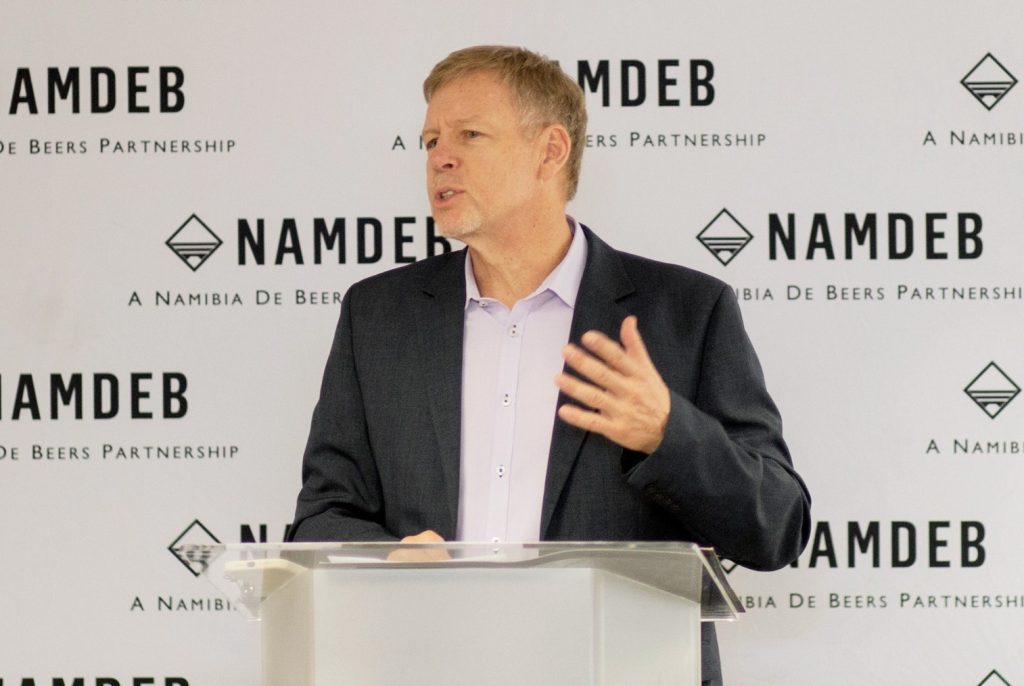
Namdeb Chief Executive Officer Riaan Burger told Namibia Mining & Energy that the company’s strategy is centred on reducing operational costs while sustaining production.
He said the focus is on improving efficiency in stripping operations, the process of removing overburden sand to access diamond-bearing material, which remains the most expensive component of Namdeb’s mining operations.
“We need to reduce our unit costs with the current state of the market and also in terms of the outlook going forward. We have to step down costs significantly over time,” Burger said.
Burger said the company has introduced a Dry Mining Unit (DMU), designed to carry out part of the stripping process more efficiently and lower the cost per tonne of material handled.
The technology is new to Namibia, although it has previously been deployed in other mining jurisdictions internationally.
“The DMU is the first unit that we’re bringing onto site that does part of our stripping process and it reduces the cost per tonne significantly. It’s new technology for Namibia, it’s been tried elsewhere in the world but never in our application,” he said.
According to Burger, the first unit has already been delivered and is currently undergoing commissioning, with production expected to start later this year.
He said Namdeb plans to gradually introduce additional units over the coming years as part of a phased rollout strategy.
“We procured the first unit, it’s on site, it is being commissioned and the intention is to start production already from that during the course of this year. And then the plan is over the next couple of years we will add more and more units,” Burger said.
Despite weaker demand in the global diamond market, Burger said the company is not considering production cuts and intends to maintain current production levels.
“So we’re not looking at any production cuts at the moment. We are performing at the optimum level for our operations and the level of production that we’ve got now or slightly more is what we need for the current market conditions,” he said.
Burger said Namdeb’s broader cost reduction strategy targets a consistent decline in unit costs of about 5% per year over the next several years.
“We need to bring unit costs down consistently over the next couple of years in terms of our planned budget by another consistently about five percent per year,” he said.
According to Burger, the DMU system is expected to reduce stripping costs by about 15% over the long term as more units are introduced into operations.
“The DMU of the stripping process, we expect that to have impact for about fifteen percent of that process over the long term,” he said.
Namdeb plans to deploy the technology progressively between now and 2030, with the performance of the first unit expected to guide the pace of expansion.
“So depending on the test results, that will determine the planning. We can call it piloting, but this is a production unit. It’s not small scale, it’s full scale. But we need more of those units, I think up to about six in the end,” Burger said.