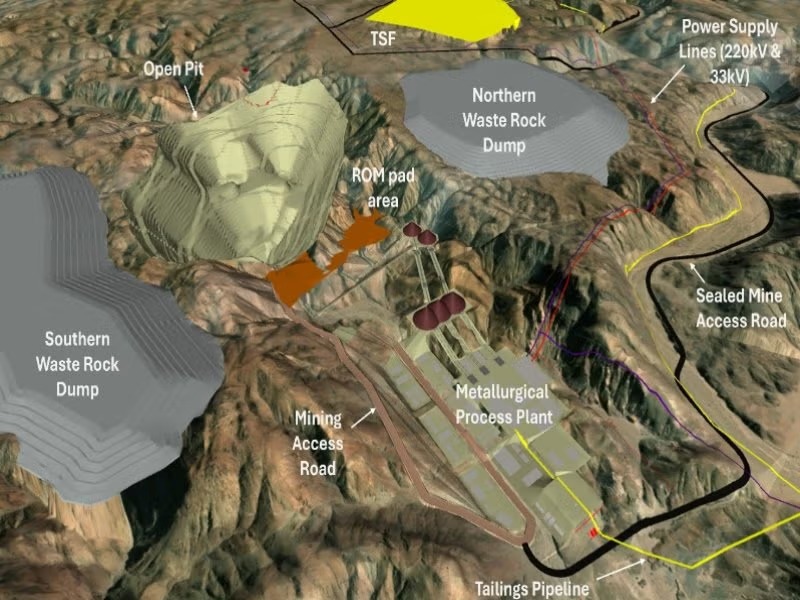
Namibia’s national water utility, NamWater, is seeking environmental clearance from the Ministry of Environment, Forestry and Tourism (MEFT) to develop water abstraction and storage infrastructure to support Koryx Copper’s proposed Haib project in the //Karas Region.
According to an environmental scoping study, the centrepiece of the proposal is a large-scale off-channel storage dam designed to secure a reliable water supply for mining operations while managing environmental impacts on the Orange River.
“NamWater seeks to apply for an Environmental Clearance Certificate (ECC) for the development of water abstraction, supply and storage infrastructure to support the water requirements of the proposed Haib Copper Project on EPL 3140,” the document states.
The project is expected to require around 20 million cubic metres of water annually, with the Orange River identified as the preferred source based on technical and financial considerations.
To support this, NamWater has proposed the construction of a concrete-face rockfill off-channel dam with a storage capacity of up to 25 million cubic metres.
The plan also includes abstraction infrastructure with a capacity of 2 cubic metres per second, alongside two potential pipeline routes ranging from 8km to 45km, including a terminal reservoir.
Supporting infrastructure will include booster pump stations, access roads and transmission lines.
“A range of potential raw water supply sources were investigated and evaluated, and sourcing water from the Orange River proved to be the preferred option from both a technical and financial perspective,” the report states.
Beyond water supply, the project is expected to generate employment, with up to 3,500 jobs during construction and around 1,350 positions during operations.
Koryx Copper has previously indicated that it is working with NamWater to assess both the Orange River and Neckartal Dam as potential water sources for the project.
The company said both options are being evaluated through trade-off studies considering capital and operating costs, technical feasibility and regulatory requirements.