Osino Resources has revised its investment estimate for the Twin Hills gold project near Karibib to approximately US$450 million (N$8.5 billion), up from an earlier projection of US$400 million (N$7.5 billion), citing enhanced environmental measures as a key driver of the cost increase.
According to Ralf Schommarz, Osino Resources’ Manager for Operational Readiness, the increased expenditure is largely due to the adoption of dry stacking technology for tailings management — a more environmentally sustainable but costlier method.
“We’ve made a deliberate decision to use dry stacking for our tailings, which is a more sustainable option, especially in a water-scarce region like this,” Schommarz said. “That decision alone has pushed the project cost up significantly, but it aligns with our long-term environmental and operational goals. In this semi-arid climate, conserving water is not just a priority, it’s a necessity.”
Construction of the Twin Hills mine is scheduled to begin in the fourth quarter of 2025 and is expected to take approximately two years to complete. Once operational, it will be one of the largest gold mines in Namibia, with a processing capacity of five million tonnes of ore per annum.
“This is crucial because when you’re investing US$450 million to build a plant, you must know exactly what you’ll feed into it, especially in the first few years,” said Schommarz, noting that extensive geological modelling has been conducted. “That early cash flow is vital. You can’t afford to run in negative cash flow for too long — shareholders expect returns as soon as possible.”
Compared to other local operations, the scale of Twin Hills will be substantial. The Otjikoto Mine, operated by B2Gold, processes around 3.8 million tonnes per year, while Navachab has increased its capacity from two million tonnes to about three million tonnes annually.
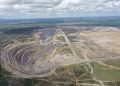
“In terms of scale, this is going to be a flagship operation,” Schommarz stated. “We’re talking about a large open-pit mine with four starter pits, each targeting the highest-grade ore first. That strategy allows us to maximise early returns, and as operations continue, those pits will be expanded further into the ground.”
The processing plant will employ a carbon-in-leach (CIL) system, differing from the carbon-in-pulp (CIP) process used at some neighbouring mines, but achieving comparable gold recovery outcomes. The facility will include major infrastructure such as a coarse ore dome, a leaching circuit, and a filter plant dedicated to tailings management.
“If you were to visit the site in two years, you’d see the full setup, from the massive crushing facility to the leaching tanks and right through to the filter plant at the back end,” Schommarz explained. “This is where the tailings are processed and dewatered. The goal is to extract as much water as possible before stacking the dry material. That’s what dry stacking means, and it’s what helps us recycle a large portion of our water.”
The tailings storage facility will feature an impermeable lined membrane to prevent seepage. Dry tailings will be stacked via conveyor belts, with a water recovery system in place to return any residual water to the plant.
Water for the mine’s operations will be sourced from a combination of local aquifers and a plant dam, with supporting infrastructure to be developed.
“We’ve identified multiple water sources, and infrastructure will be built to ensure a stable supply,” said Schommarz. “That includes pipelines from Karibib to the site, and two local extraction points that will feed directly into our processing system. It’s a well-thought-out water strategy that supports both sustainability and operational efficiency.”
The project’s advancement follows the acquisition of Osino Resources by Shanjin International Gold Co., Ltd. — formerly Yintai Gold — for approximately C$368 million. The transaction, finalised on 29 August 2024, received all necessary regulatory approvals, including clearance from the Namibian Competition Commission.
Shanjin International is among China’s top five gold producers, with an annual output of 10 tonnes of gold and 190 tonnes of silver from its portfolio of four gold and one silver mine. Twin Hills marks the company’s first venture into Africa and its sixth mine globally.
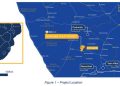
The Twin Hills Gold Project spans 11 exclusive prospecting licences (EPLs), covering 153,206 hectares in Namibia’s Erongo Region.