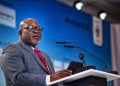
Finance Minister Iipumbu Shiimi says reducing capital costs is essential for the success of Namibia’s green hydrogen industry.
He said lowering the cost of financing will make projects more profitable and ensure the sector’s growth.
“This is a new industry, and it has to be supported with capital that will make it more affordable. If we don’t coordinate the cost of capital, it will be difficult for this industry to take off,” Shiimi said.
Namibia has already created the Welwitschia Sovereign Wealth Fund to attract capital from development agencies, governments, and commercial investors, which Shiimi described as a critical step towards supporting green hydrogen initiatives and broader natural resource development.
“One example we have done in Namibia, coming from the finance sector, is creating a fund to raise capital from different sources—development agencies, governments, and commercial entities,” he noted, adding that the fund aims to support not only green hydrogen but also Namibia’s green industrialisation efforts.
Shiimi highlighted the importance of reducing capital costs for these projects, which will provide authorities with a stronger foundation, increasing their profitability and cost-effectiveness.
“There are projects in the pipeline, such as those we’ve seen materialise in recent months. How do we help ensure proper coordination and establish the infrastructure where these projects operate? Because the molecules and electrons they produce need to be transported,” he said.
He explained that Namibia requires pipelines, transmission infrastructure, and harbours to support the movement of hydrogen-based products, both locally and internationally.
“As a government, we must invest in infrastructure, working alongside the private sector, to ensure these products reach internal, regional, and external markets,” he said.
Shiimi stressed the importance of continued collaboration with international partners.
For example, he referenced the European Union (EU) agreement with Namibia on critical raw materials, which includes discussions on processing and creating off-take opportunities.
Shiimi also mentioned the H2Global initiative from Germany, which he described as a vital policy instrument that will provide significant support for the green industry.
“In Namibia, we need to strengthen these partnerships with governments and the private sector to enable projects to become profitable. There’s still a lot of work to be done in these areas, and we are committed to addressing them,” he said.
German State Secretary Jochen Flasbarth noted that Namibia, along with other countries, is well-positioned to achieve energy and electricity system decarbonisation in tandem with the growth of green hydrogen production, providing a significant advantage.
However, he noted that “Germany is a key partner in the development of green hydrogen and its derivatives. We must avoid locking our partners into outdated, fossil-based strategies with our invoicing approach. It would be unethical to support decarbonisation efforts on our end while our partners continue exporting green products using fossil fuel capital.”
He said this transition will not occur automatically. Despite Germany’s stringent regulations, including the goal to be carbon-neutral by 2045, the industry must be equipped with a solid foundation for this decarbonisation.
“Additional instruments, such as the global mechanisms you mentioned, and further regulatory measures are essential to overcome the first-mover challenges,” he said.
Flasbarth said the feed-in tariff, and while it may not be sustainable long-term, it played a crucial role in advancing the global learning curve in renewable energy.
“Germany, along with a few other pioneering countries, initiated this effort, and while others, such as China, have since contributed, there is still much work to be done globally.”
The German Feed-in-Tariff aims to promote renewable energies to produce less greenhouse gas emissions for a healthy environment.